On our way back from our Monday picnic on the Michelson Trail, we stopped by the site of the DAR sponsored “Penny Forest”. We took a 4WD road up the hill and came across this site along side the road. Evidently, when a pipeline was being installed in the 1980s the construction company came upon this area containing “artifacts, fossils and ancient ruins”. This is one of several “holes” that have been subsequently excavated by persons looting the area.
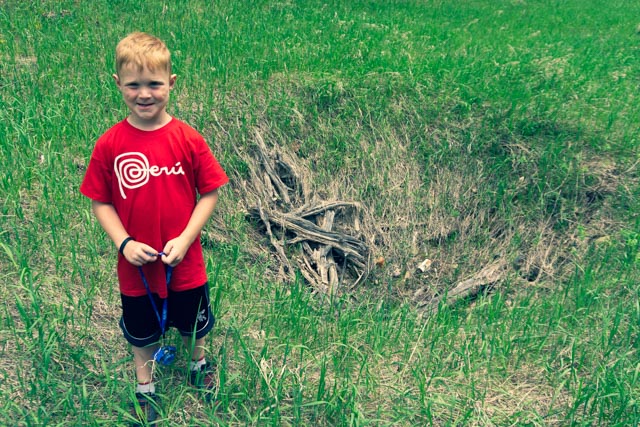
Jason is standing in the bottom of one of the larger holes.

We continued back to our camp in Spearfish. I dropped Jason and Cathy at the park while I continued on the MH to pick up my laptop and head to the library. Heavy rainfall and very close lightning appeared out of nowhere so Cathy and Jason beat me to the library, barely missing the brunt of the storm.
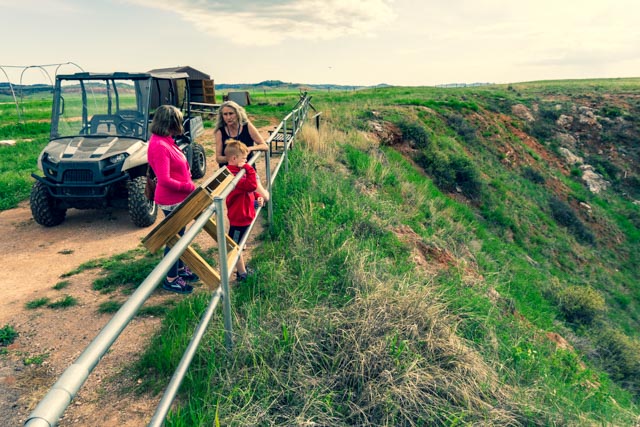
On Tuesday morning we passed the Vore Buffalo Jump site on our way to Montana and behold, the site was open as of June 01. We stopped to let Jason see the site and he met the docent who elected to give him a special tour. The Vore family still owns the adjacent acreage and their son volunteers at this facility regularly.

You can look down into the hole that was discovered by the highway crew when building Interstate 90. At that time this appeared to be a collapsed cave and core samples show evidence of almost solid bison bones and Indian artifacts, including arrow heads and clubs.

Jason’s private tour guide, Miss Katie, explained how the natives used this area to hunt, trap and kill the bison.
Katie took a piece of gypsum that is natural to the area and wrote Jason’s name on the sidewalk before giving the rock to Jason.

Here Katie is digging with Jason to find an arrowhead.

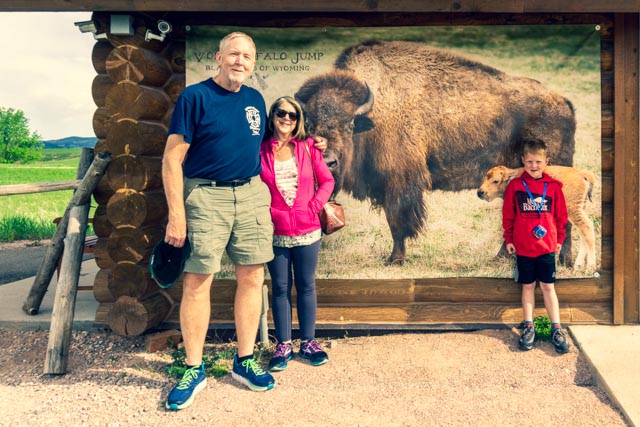
Katie took this picture of us at the entrance to the Buffalo Jump.
Jason is standing in front of “Last Stand Hill” where the markers in the field behind him represent where the 41 soldiers fell during the short, final battle. Their horses, whom they shot and used for breastworks on the battle are also buried here, just yards from the mass gravesite.

This is the memorial where the mass graves of about 260 (enlisted) soldiers from the battle are buried. A total of about 60+ Indian warriors were killed in the battle. Most of the officers were buried separately within five days after the battle. The enlisted were left in the fields and were mostly unrecognizable when moved to this site.

We attended a “Battle Talk” on the patio of the Visitor Center. The ranger was a college teacher from Texas who has been giving these talks for 30 years during the summer. He was very knowledgable of the battle history and the individuals involved. Jason remained fairly attentive during the talk and actually engaged the ranger in the discussion. He is working on his Junior Ranger program for this site along with the Devil’s Tower and Mt. Rushmore programs. He will continue this through Canada and into Alaska.
In the morning we are planning on hiking most of the interpretive trails, including the Deep Ravine, Keogh-Crazy Horse and the Reno-Benteen Battlefield. It’s going to be a full day!
Wednesday
We stopped by the National Cemetary to see the gravesite of Marcus Reno. Marcus was deeply involved in the Custer/Sioux battle here (Reno-Benteen Battlefield) and had a history of drunkenness (he was supposedly supported by a bottle of whiskey during the battle) and we were told that he wanted to be as far removed from this battles as possible. His family wanted his status reviewed in the early 1960s, was judged exonerated and was reinterred at this National Cemetary with full military honors just before it became full. Ironic?

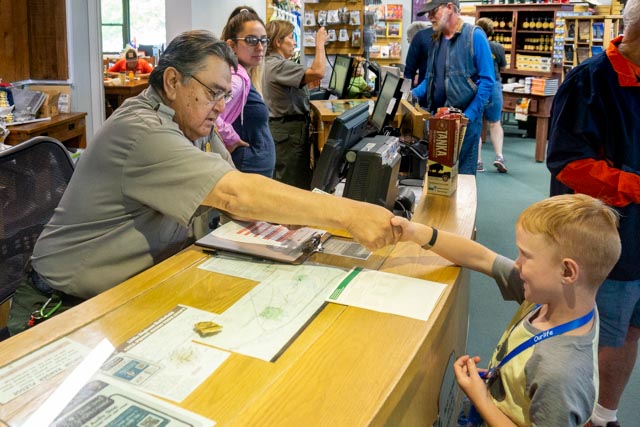
After attending the video presentation this morning, and revisiting the museum, Jason managed to answer the last of his questions to earn his Junior Ranger badge for the National Monument. Here he is accepting the congratulations from the administering ranger, with his newly earned badge on the table.
We took the Junior Ranger on a drive/walk through the battlefield and saw these Indian ponies on the adjacent Crow Indian Reservation, the largest reservation in Montana, encompassing approximately 2.2 million acres. There are 11,000 members of the tribe, of whom 7,900 reside on the reservation. Eighty-five percent speak Crow as their first language.
The tribe is originally called “Apsáalooke,” which means “children of the large-beaked bird.” White men later misinterpreted the word as “Crow.” The reservation’s economy is derived from the rich resources, including a large deposit of coal of the Tribe’s land, which is used directly to support livestock and other operations.

We may get around to rinsing down the motorhome this afternoon as we came through more than a thousand miles of rain and have permission to use a limited amount of water. It is hard to believe we had it squeaky clean as we left GA. We are not going to attempt to clean our truck though, even though you can’t tell the color through the dirt and caked-on mud. We are headed for Dawson City via Top-of-the-World Highway (about 200+ miles of dirt, mud and dust) and the Arctic Circle/North Slope (about 500 miles of dirt, mud and dust) before returning to Fairbanks (and pavement).

 Travelling with the Schinglers
We couldn’t bring ourselves to go to the place where they drove the buffalo over the cliff, but did enjoythe restof it.
LikeLike