Friday
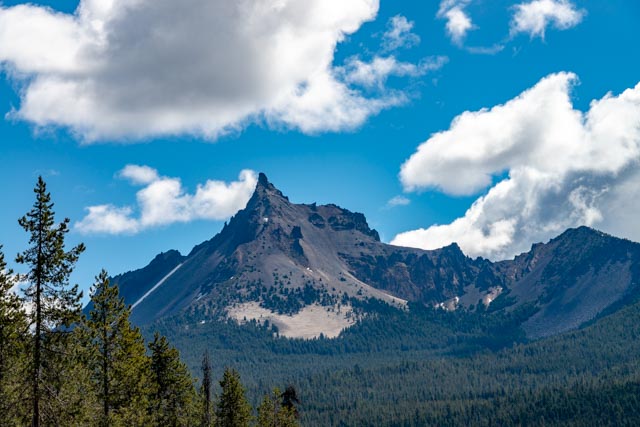
We left Crater Lake (the former Mt. Mazama) via the Rouge/Umpqua Scenic Highway, destination: Coos Bay. We passed horn-shaped Mt. Thielsen, in the Cascade range just north of Mazama (9,182 ft) on the way out. We saw this pointed peak on the way into Crater Lake two days ago and it looks even more spectacular from this side. We stopped at an informational rest stop and learned that this point was within the blast zone of Mt. Mazama and 1,200 degree winds hit this point at over 200 mph, vaporizing every living thing in its path, but that was 7,000 years ago. To put this blast into perspective, the St. Helens blast released .1 cubic mile of debris into the air, Mazama released 18 cubic miles! Even Mt. Lassen (which we are scheduled to visit in a week) released 15 cubic miles and that was in the 20th century!
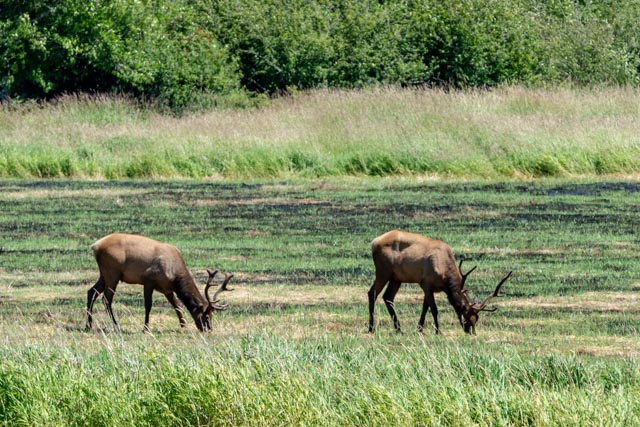
After fueling in Roseburg, we continued westward on the Umpqua Scenic Highway, through Elkton and Scottsburg, stopping only to watch this herd of elk.

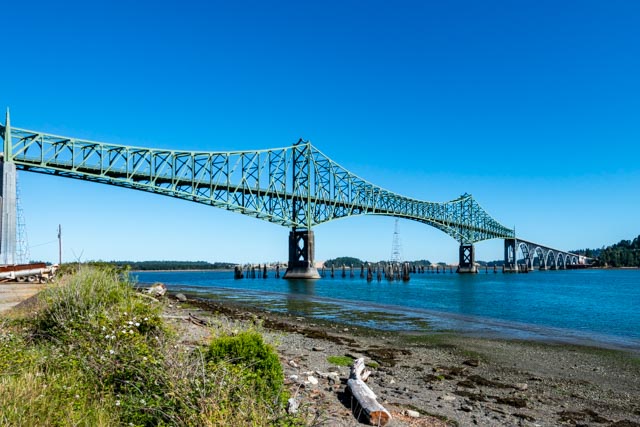
This is the bridge crossing the Umpqua River into North Bend and Coos Bay.
After taking the GPS-guided long way (almost an hour) to camp (in nearby Charleston), we enjoyed a seafood dinner within walking distance.
Saturday
In the morning we headed to Coos Bay (the short way, about 10 minutes). Our first stop was the Coos Bay Museum but we quickly found out we really wanted to visit the Coos Bay Art Museum, which holds some of the Prefontaine memorabilia as well as numerous original photographs highlighting his career. We parked near the Prefontaine wall downtown and Cathy took this shot of Jason and me in front of high school (Marshfield High) Steve and college (University of Oregon) Steve.

Jason then posed with Olympic (Munich) Steve.

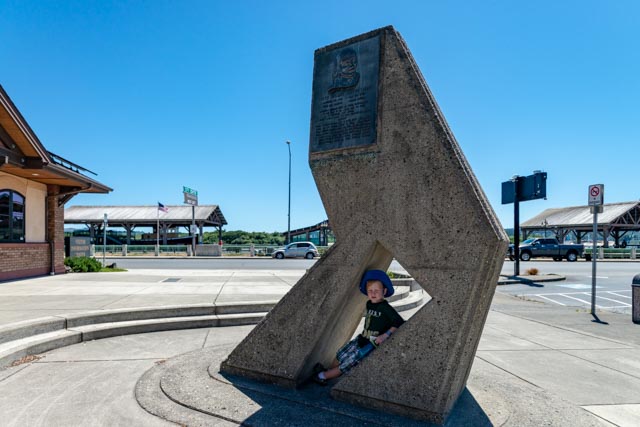
This is the Steve Prefontaine Memorial near the visitor’s center in downtown. This monument was placed here in 1980 displaying a bronze likeness and a list of all his American records held at the time of his death.
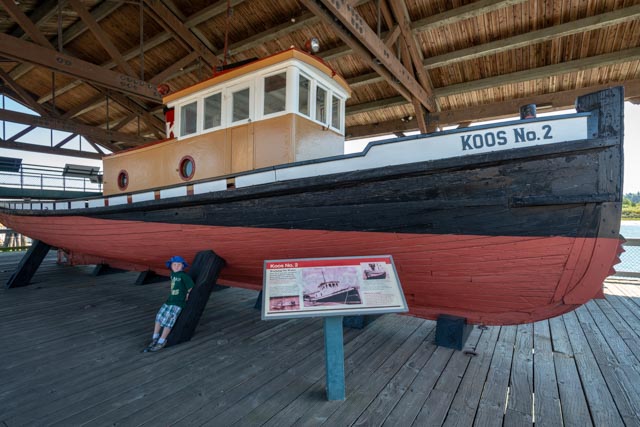
The KOOS No. 2 is in the covered exhibit in the left background.
This is the KOOS No. 2. Jason enjoyed running up the viewing platform/incline surrounding the boat, then down the stairs behind the boat several times. The KOOS No. 2 was the second of several tugboats with the KOOS name to work for the Knudson Towboat Company. It was built in 1924 by Frank Lowe at the Marshfield shipyard and was placed into service with her sister tug, the KOOS.
The Art Museum opened at 1:00 so we stopped at the boardwalk near the KOOS for lunch. The small restaurant/fish store was recommended by the local chamber representative and we discovered it was floating. As you “boarded”, a tsunami warning placard was displayed, which read “In the event of a tsunami alert, RUN LIKE HELL”
We arrived at the Art Museum and proceeded upstairs to the Prefontaine room. The cabinets holding some of Steve’s awards were made by his father Raymond, who passed away in 2004.
It is not the quantity but the quality of these awards . . .7 NCAA Championships, won the gold medal at 5,000 meters at the 1971 Pan American Games, 14 American records, and held seven at his passing in 1975 at distances between 2,000 and 10,000 meters. Steve never lost to an American runner at a a distance greater than a mile. He set his first state record in the two-mile in 1968 while a junior at Marshfield at 9:01.3 and as a senior, shattered that record at 8:41.5! He won the 5,000 meters at the Olympic Trials and challenged a formidable field (some say the best field ever assembled for that distance) into the last curve, only to lose a certain medal because he refused to run for anything but first place.
Beyond the records, Pre will always be remembered for his outspoken advocacy for the rights of track and field athletes, which eventually forced track’s governing body to give athletes a greater voice in controlling their own destinies.
The wooden plaque on the right cabinet is the model for the Prefontaine Memorial. The room is lined with the original photographs of many of his wins including his last race, on the evening he died (in which he won).

Cathy and Jason watching a short film on U of O track coach Bill Bowerman, co-founder of Nike and Steve.

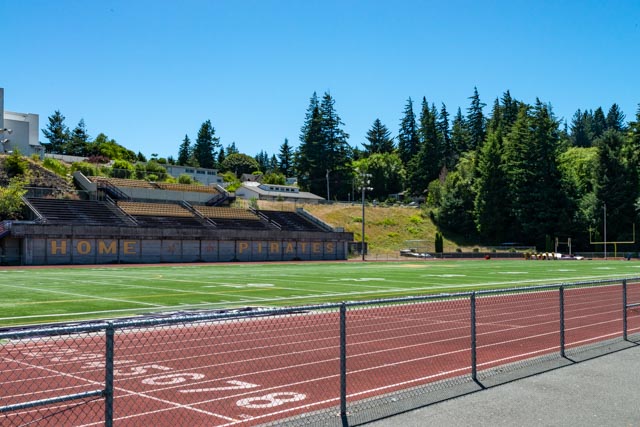
This is the track from which Steve launched his running career at Marshfield High School.
This is Steve’s final resting place in Sunset Memorial park just south of Coos Bay. He was known as “Pre” and “World” and the Olympic rings are on his headstone. He was determined to run in the Montreal Games. There is a very well attended 10,000 meter race held annually in Coos Bay, the “Pre Memorial Run” following one of Pre’s training routes. It is lined with five bronze plaques inscribed with his famous quotes on running. High school track teams from the area assemble here to challenge each other in the event and it hosts participants as old a 90 year (I still have some time). I drove the course . . holy smoke there are very steep climbs. I was told this is where he did his “hill repeats”.

After the Prefontaine morning, we took Jason to meet the Pacific Ocean. The water was a little colder than what he is used to (Gulf Shores, AL) but he enjoyed himself and “fell in” several times nevertheless.

He found some little friends swimming about.

We watched some ships heading for the breakwater so we went back in the late afternoon to show him where the ships were headed. This is one of the trawlers entering the wharf area. We watched this one from the beach earlier.
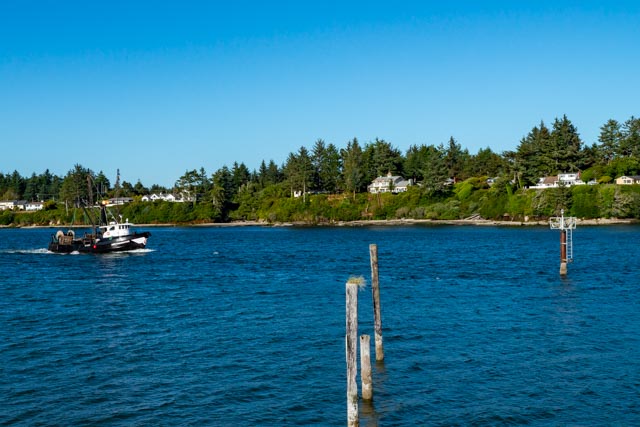
The trawler docks directly behind our camp.


Just beautiful
LikeLike
We used to camp at Sunset Bay State Park and crab at Charleston. The kids used to see who could hold their breath the longest going over that bridge!
LikeLike