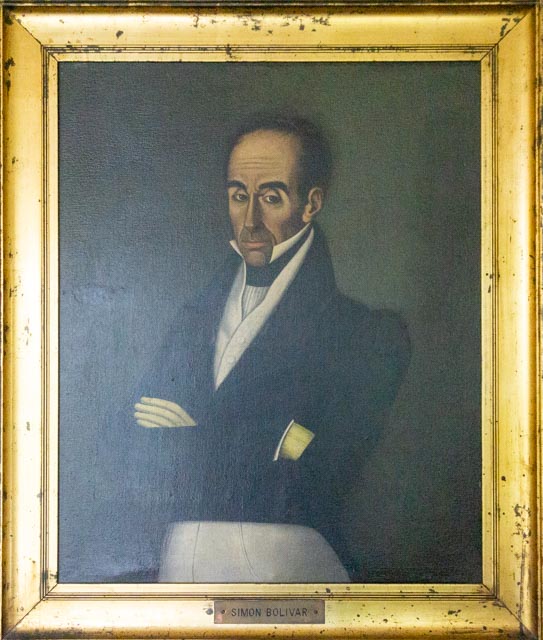
We walked through the Colombian residence of Simón Bolívar. Born in Caracas, Venezuela in 1783, Bolívar was a Venezuelan soldier and statesman, and died in 1830 near Santa Marta, Colombia. Simón was refferred to as “El Libertador” because he liberated Venezuela, Colombia, Ecuador, Peru and Bolivia from Spanish rule. He held office as President of Colombia, Peru, and Bolivia and Dictator of Peru from 1823-1826. He is sometimes referred to as “the George Washington” of South America. We had previously visited the Simón Bolívar home in Peru.

The living room looked pretty simple and comfortable for the president. You can see the piano at the left of the photo.

The dining area was pretty formal with plenty of seating. I would expect the Mr. Bolivar has quite a lot of “guests” and travelers over for dinner.

This is a photo of the informal office or study area of the home. The desk on the left was loaded with period books.

Simon Bolivar’s bedroom. You can see from the size of the bed that he was not what we consider “tall.”
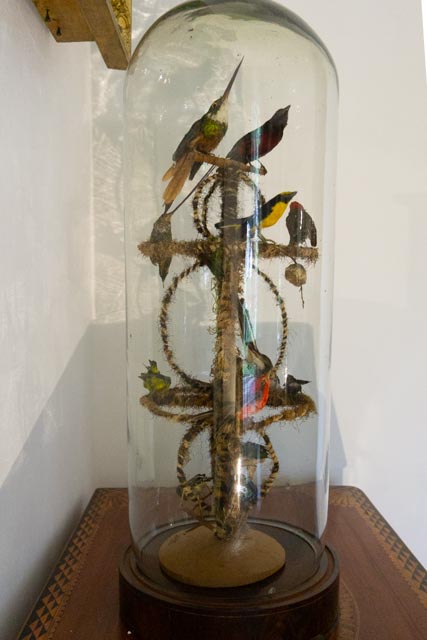

Simon was a collector and a researcher of all types of flora, fauna, and native animals, including a passion for birds.

This was the kitchen food-prep area for the estate. Note the contraption to the right of the back door? More on that later . . .

The “stove” in the kitchen.

I walked around back, past the water collection basin and stuck my camera in through the back door. This is a water filter. Water, dipped from the collection point just outside this door, was poured through the stone basin on the top of this rack. “Filtered” water would fill the jug at the bottom. This is pretty rudimentary by also pretty ingenious.

This is the water collection area, located behind the kitchen.
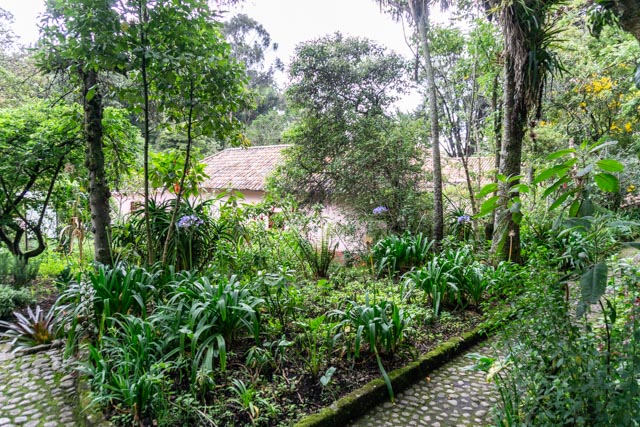
Since we were almost by ourselves, I walked though the acreage, following narrow footpaths. Bolivar collected plants from many places and was very interested in studying the plant life.
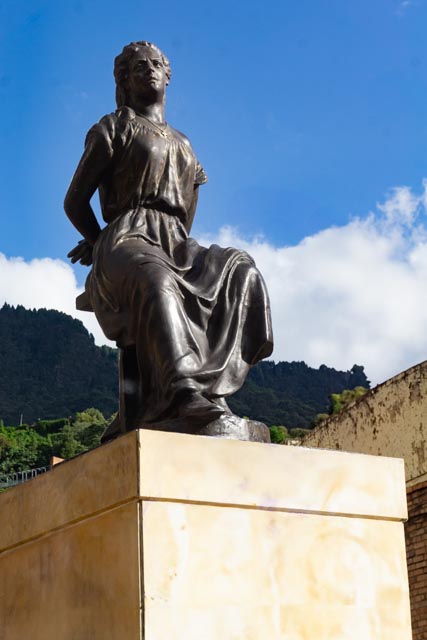
This is the monument to Policarpa Salavarrieta, 1795-1817. She was also referred to as “La Pola.” She was a seamstress who spied for the Revolutionary Forces during the Spanish Reconquista. She was captured by Spanish Royalists and executed for high treason. The Day of the Colombian Woman is commemorated on the anniversary of her death. Considered a heroine in Colombia, she was featured on one on the currency notes. La Pola was the first woman to be featured on a Colombian banknote, debuting on the two-peso gold banknote in 1963. In 1995 she reappeared on the 10,000 peso note.
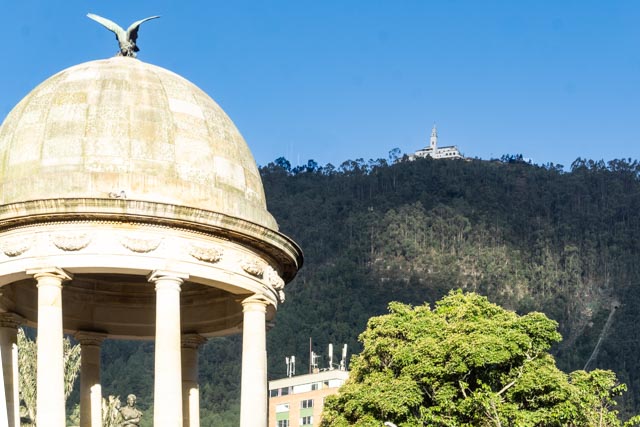
A last look at Mt. Monserrate and the sanctuary. The funicular to the top can be seen on the bottom right of this photo. The mountain rises about 2,000 feet above Bogota.

 Travelling with the Schinglers