We stopped at The Fur Rendezvous Festival information building in downtown Anchorage to find out what “Rondy” was. Rondy (aka Fur Rendezvous, Fur Rondy, or simply Rondy) is an annual winter festival held in Anchorage in late February. The self-styled “largest winter festival in North America”, Fur Rendezvous marks the beginning of the end of a long winter and the approach of spring and is held during the Iditarod race, which is shown on large screens throughout the festival. Cathy is standing with a sled dog statue designating the starting line of the Rondy World Championship Sled Dog Races and the Iditarod.

After learning a little about the Rondy activities, we headed over to the Saturday market. This young gentleman was playing the violin beautifully, classical music of course, and collecting donations towards his musical education.

I was asked (by me) to pose with Mrs. Alaska at the Kids Eat Free area at the market. Always the trouper.

In the morning, we headed down the Seward and happened upon these two Dall sheep, in the Windy Point area. I managed to pull the motorhome over in a wide area across the highway and walk back to photograph these two before they headed up the mountain.
We stopped for lunch at the intersection of the Seward and Sterling highways. I remembered that there was a wide spot in the road here and the view from the motorhome was outstanding on our last trip. There is a salmon viewing station at the outlet of these ponds about a mile downstream.
We stopped again near Anchor Point to take a couple of pictures in the hazy afternoon of Iliamna Volcano and

further north, the Redoubt Volcano, both positioned directly across Cook Inlet from the Sterling Highway. These mountains are part of the Aleutian Range and are located in Lake Clark National Park and Preserve, a prime brown bear viewing area. Anchor Point is “North American’s Most Westerly Highway Point”.

We arrived in Homer mid-afternoon and set up camp on the spit facing Kachemak Bay. Homer Spit juts 4.5 miles into Kachemak Bay and marks the end of the Sterling Highway. We could clearly see from our windshield the Grewingk, Portlock and Dixon Glaciers in Kenai Fjords National Park, directly across from us, especially in the morning before the air moisture builds.
In the morning, we set out for the Russian “Old Believer” community of Nikolaevsk, located about 10 miles east of Anchor Point on the North Folk Road. Nikolaevsk currently has about 350 residents. We have previously visited two other Old Believer communities, Voznesenka and Razdolna, both located about 23 miles down a gravel road out of Homer but we failed to find the road to Nikolaevsk on our last trip. We did a little more research and located it this time.
We stopped at the beach at Anchor Point to take a short drive on a beach, which is accessible by four wheel drive vehicles. As we neared the water our tires began spinning and we got a little sideways so we brought the truck back up to the harder surface. If you get stuck here, you have very little time to get free, as the tide may quickly rise 25 feet above the beach. The name “Anchor Point” comes from a legend that when Captain James Cook discovered the area, he lost an anchor. Settlers came beginning in the early 1900s. This is the sand which can be treacherous.

Here we are, off the sand and safely on the gravel bar with Iliamna Volcano in the distance.

After our stint on the beach, we headed inland to the community of Nikolaevsk. This was the first Old Believer Russian Orthodox Old-Rite church
Behind the older church, we found the newer church , still in construction stage. The door was open (it actually hasn’t been installed yet) so I walked in to see the interior.

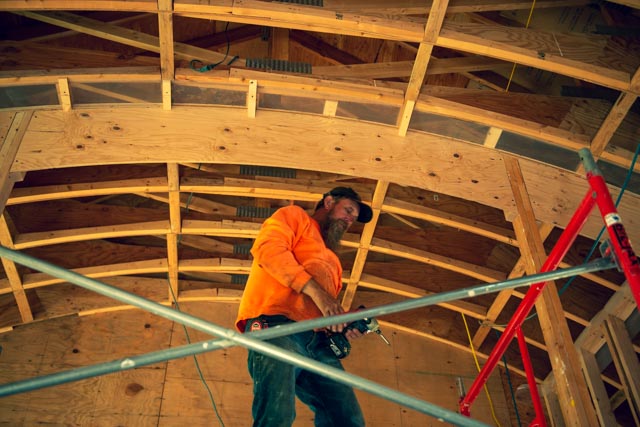
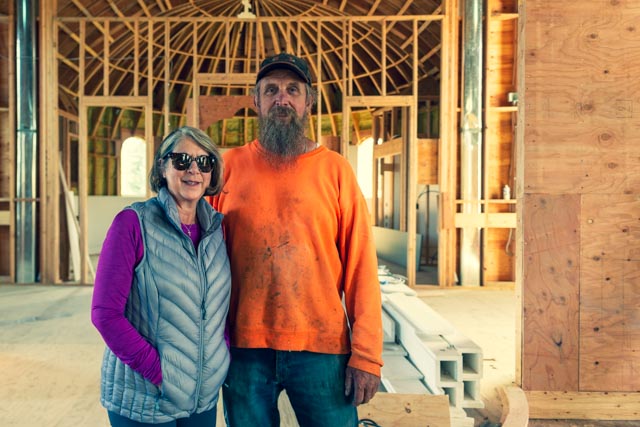
Inside, I met this carpenter, son of Rev. Kondraty Sozontovich Fefelov, who, at eight years of age was taken by the Russian Communists and later escaped to China with his family. When communism arrived in China, he went to Hong Kong, then on to Brazil, then to Oregon and finally, in 1969 settled in Nikolaevsk, Alaska, whose climate closely resembled his original home. He traveled to Romania with six other families seeking the true religion and discovered the Old Rite Orthodox Church in its pure and unchanged form, where he was baptized. He studied to become a priest and was ordained in 1983. He built a church in Russia, in Oregon and in Nikolaevsk. He passed away in 2008 and his son Sev (shown below) has been building this church for seven years. He expects it to be completed within the next seven years if the funding continues. He was a pleasure to talk with and very honest and open in his conversation. We will watch the progress of this church and would like to return to see it complete. The workmanship was outstanding, with all of the arches, curves and “onions” located on the steeples.

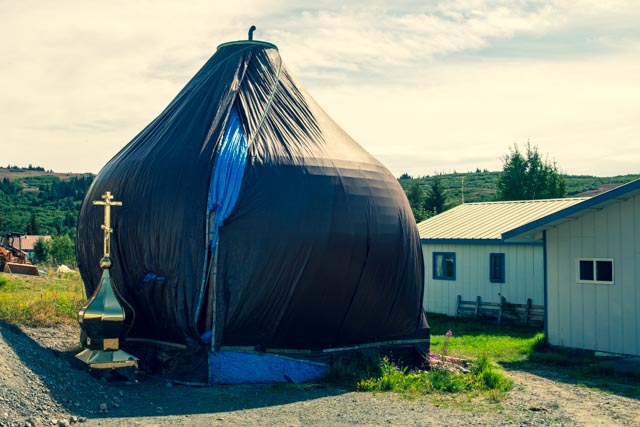
This is the “onion” (his word) that he built inside the main building, then unassembled it, took it outside and reassembled and covered it until they can get it to the top of the roof.
He also built this piece to go on the top of the larger piece shown covered above. He turned it on its side to show me how he build it with layered plywood. Amazing.

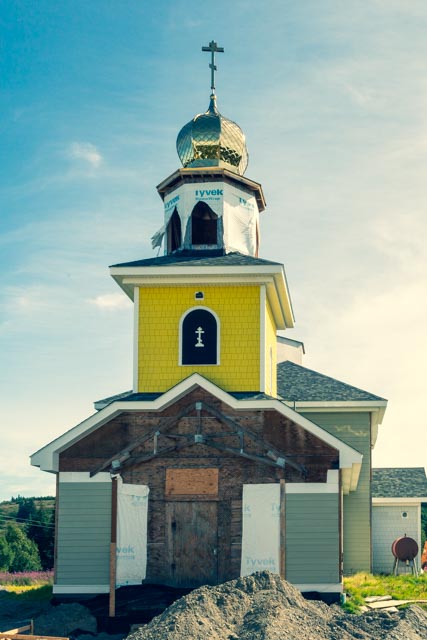
This is one of the smaller onions already installed on one of the steeples.
This is the gravesite of Rev. Fefelov.

I called Cathy in to meet Mr. Fefelov and we were both impressed by his hospitality. He is a true craftsman.
Leaving we took this final shot from a different angle to show the level of completion of the exterior. You can see where the large onion will be placed on the eight-sided platform centered on the building.

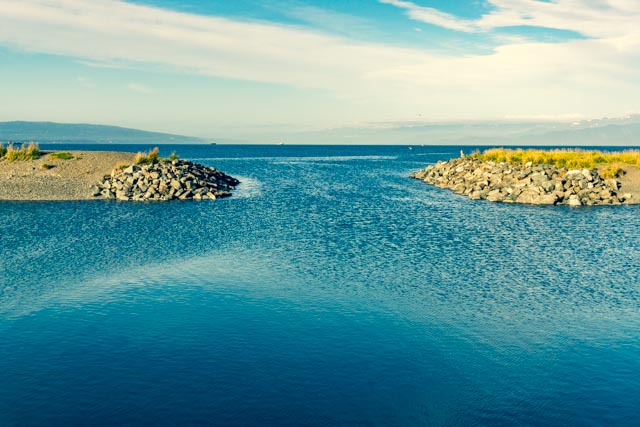
Back in our campsite near the Dudiak Fishing Lagoon, we watched the dramatic tidal change. I walked across the creek shown here, without getting my shoes wet. Sitting on the rocks on the right side, I watched as the outflow slowed to a stop, then immediately began in the reverse direction. Within minutes the area was under several feet of very swift water and within a couple of hours, the lagoon was completely full as shown in the second photo. It was wall-to-wall fishing at the mouth of this lagoon and there were seals inside enjoying the plentiful salmon.

We were lucky to see the wildflower show on this trip. Due to the warm weather, and us being about a month earlier than our last trip, the colors were outstanding. Here is my favorite, the Fireweed. It is called Fireweed because it enjoys sunshine and is the first to appear in fire ravaged forests.

These elderberries are usually with the fireweed and make a sharp contrast in leaves and colors. Together they are spectacular.
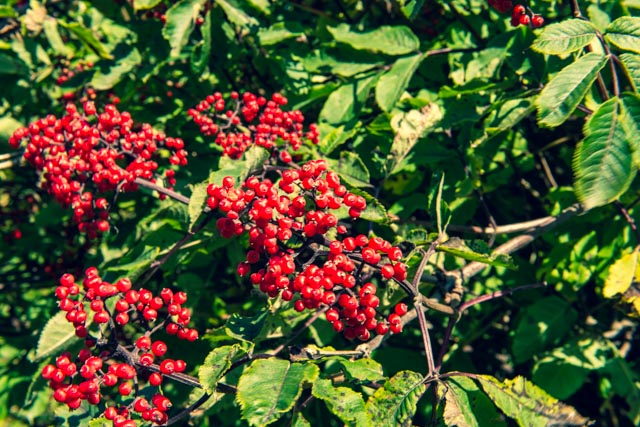
In addition to the vibrant pinkish fireweed and red elderberries, we saw fields of yellow.

On a whim, we decided to take a drive to the Kilcher Homestead. They offer tours, have exhibits, workshops and host special events. We just wanted to see the place. Since we could not find an address for them, we received directions from a local and quickly found the roadway leading to the homestead. 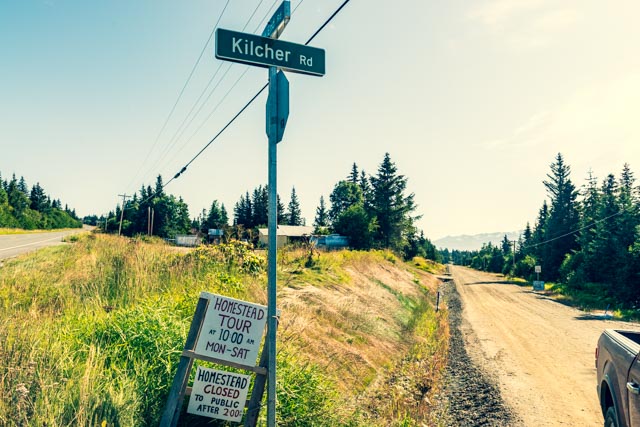
About a mile of so in, we came across this sign . . really?

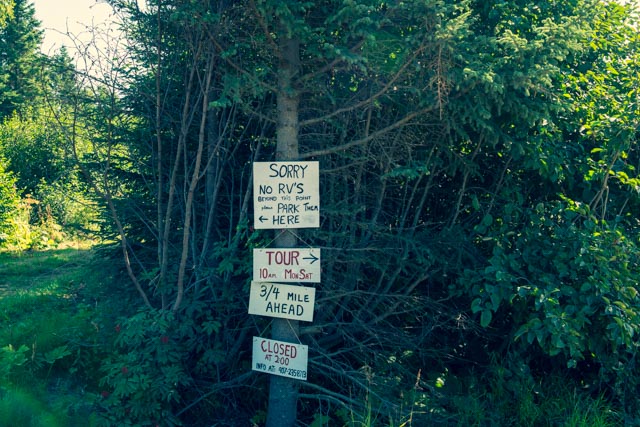
With almost a mile to go down a very dusty road, we came across these handwritten informational signs. Park your RV here and walk a mile down a dusty road? Probably not, and we soon discovered that others felt the same way!
Once we arrived at the “parking lot”, a dusty flat spot in the road, we saw this sign. I got out and took a couple of shots of the surroundings, rolled up my window and headed back up the road.

I assume this is the original Kilcher homestead. I took this through the trees.

On the way out, we saw this sign about “breakup”, which I though referred to the ice breakup in the spring in the rivers. There were no rivers here.

We passed a solar energy array and a utility pole very close to the homestead.

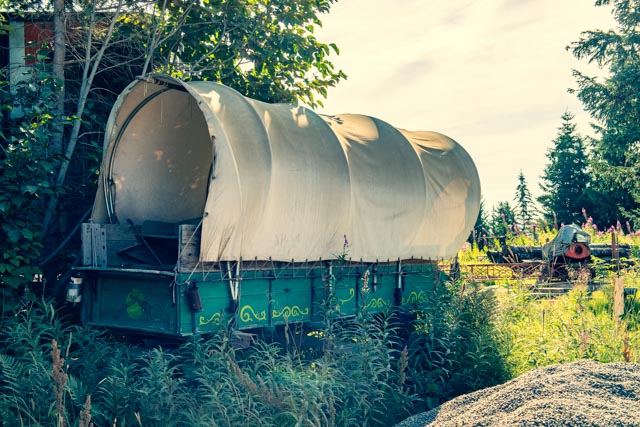
Maybe for ambiance? I have to keep telling myself, the “homestead” was founded in the early 1940s. This mode of transportation is from a slightly earlier period.
Back on the road, you can clearly see the Homer Spit and the land surrounding the airport in the distance. We measured about seven miles back to town. Not quite the “wilderness” we expected.

We did stop at Bear Creek Winery since it was on the way back into town. The gardens were not in bloom the last time we were here so we took advantage and made a walk thorough the yard. It is full of beautiful flowers and colors.
We are now at the Homer Public Library, a very impressive facility with loads of activities for children, as seems typical for Alaskan libraries.
Other thoughts:
We also visited NOMAR, which manufactures Alaskan clothing, custom gear for the fishing boats and a line of weatherproof travel bags. They were very pleasant and offered to give us a full tour of their manufacturing facility. They are perfectionists and they really take pride in their products.
In addition, we visited the Islands & Ocean Visitor Center, the window to the second largest seabird refuge in the world. There are many exhibits, films, guided hikes, ranger-led talks and hands-on activities available June through August. In addition, they have a National Geographic Bookstore and perform important biological research of the Alaska Maritime National Wildlife Refuge. It has grown extensively since our last visit in 2016 and provided me the incentive to learn more about the Japanese invasion of Alaska during WWII (which I was unaware of) and home to one of the deadliest battles in the Pacific theater during that time. There were more than 100,000 troops stationed in this area.

 Travelling with the Schinglers