2019-05-13
We spent the night in the Sacred Valley of the Incas, surrounded by two 19,000 foot peaks.
Because there was a general agricultural strike scheduled for today, our plans were amended to a short hike and a “picnic” lunch. We hiked about two miles up a hill with beautiful scenery, through a hacienda (with a guard gate, with a guard) that formerly housed Simon Bolivar, to another hacienda, high on the hill. Agricultural strikes happen yearly and completely shut down all roadways. They take their strikes seriously.
Upon arriving, the owner greeted us with a Pisco Sour, apparently the national drink of Peru. Not bad for a “picnic”.
The owner made a point to show Cathy and me his tomato tree.

His gardens were extensive and there were Inca artifacts mixed in everywhere.
After enjoying the appetizer at lunch I went to play with this guy. I had him running and bouncing into things chasing his ball. Cathy came out to find me as we had much more to eat. The actual meal was being served, with dessert. I was already full from the appetizer but what the heck, I went back into the dining room. I guess I didn’t expect the elaborate, unscheduled “picnic”?

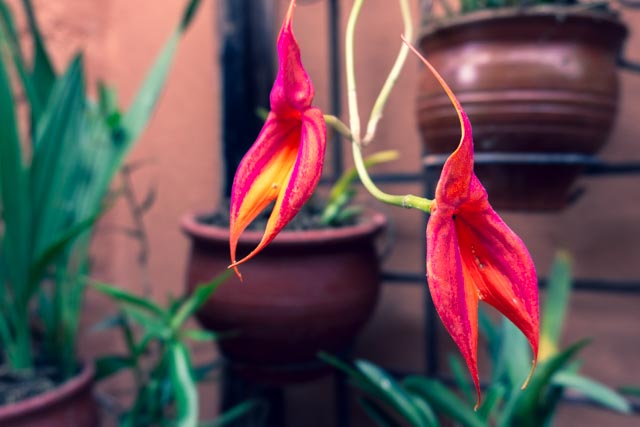
Here is a flower, beautiful and growing near the hacienda.

Wakanki (Masdevalia/veithiana/Orchidaceae – an orchid growing near the hacienda.
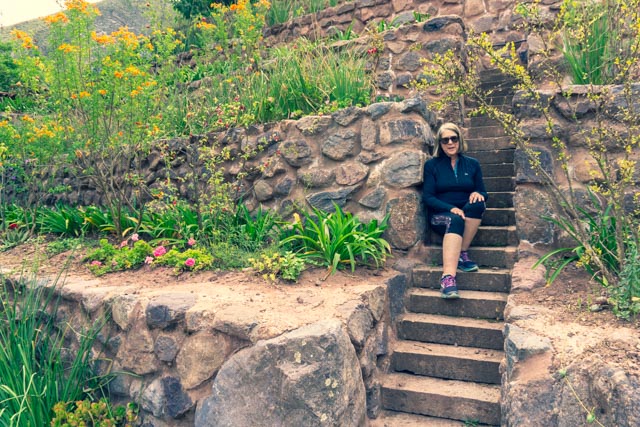
Cathy is sitting in what was a waterfall.
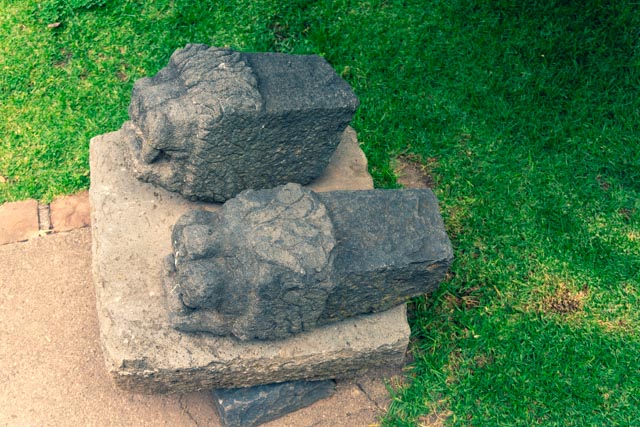
Below are two ornate ornaments with square pegs. We had seen square holes in some of the ruins and imagine that these were the fixtures that went in those holes.
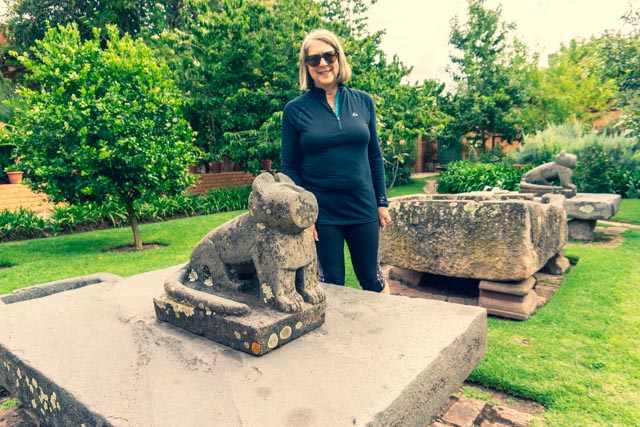
Cathy is with two Inca carved animals and a wash basin.
Our group was personally escorted through his displays of Inca and pre-Inca artifacts. These rooms were unlocked and remained open during our visit.
I like the Inca mantra: “Don’t lie, don’t steal and don’t be lazy” and they truly believe in and follow this. Another Peru mantra is “If you don’t work, you don’t eat”. It was amazing to see the restaurant workers as active as what we would see in a Waffle House! I have never seen railway workers running from place to place, items being pushed up (and down) very steep hills with overladen wheelbarrows, if fact we did not see anyone being “lazy” during our stay.
These are examples of the items that were found on the hacienda grounds over a period of time. Most of these were discovered while working the fields and were handed over to the owners by the workers. One slide has bronze instruments of war, including club heads and weapons. Some of these date pre-Inca and some are Inca era. The dark (black) pottery was as a result of being exposed to the kiln smoke over an extended period of time, absorbing much of the soot. All of these items are better examples and in better condition than most of what is found in national museums. There is a tremendous amount of Inca artifacts in private hands in Peru, all approved by the government.
The agricultural strike ended early, so we headed to the ruins at nearby Ollantaytambo in the afternoon.
This is the left terrace, one of three terraces in this ruin. We climbed the stairs to reach the Temple of the Sun and Military Zone at the top. The approach ramp is on the backside of this mountain.
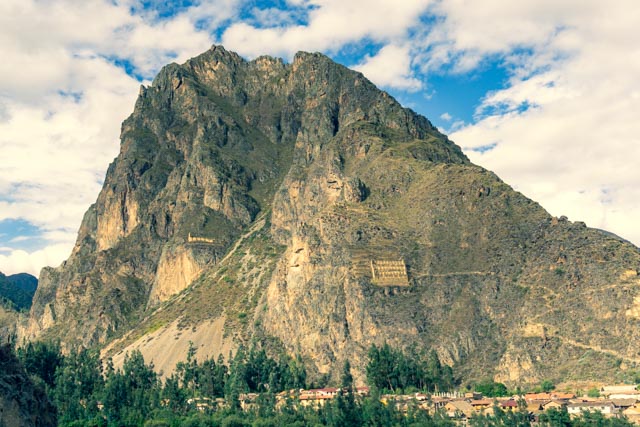
Pinkuylluna Mountain lies directly across from the terrace complex, towering over the town of Ollantaytambo. The long, narrow building on the far left are housing units and the larger buildings on the right center was qullgas, used for food storage. This location at high altitudes, where more wind and lower temperatures occur, defended the contents against decay. To enhance this effect, the Ollantaytambo qullqas feature ventilation systems. They are thought to have been used to store the production of the agricultural terraces built around the site. Grain would be poured in the windows on the uphill side of each building, then emptied out through the downhill side window.

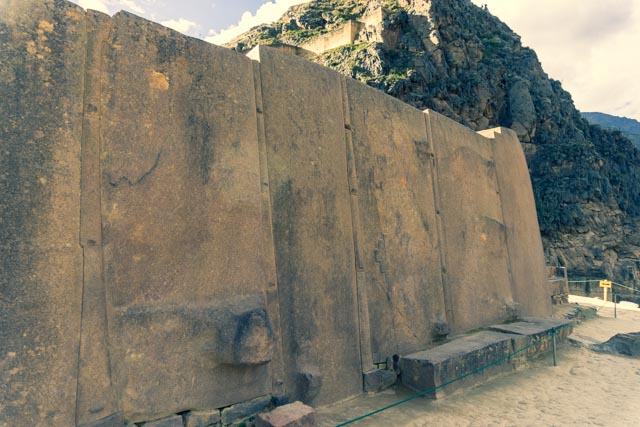
These six blocks of pink granite are joined (unusually) with long, delicate, narrow panels, similar to expansion joints, are standing at the Templo del Sol – Temple of the Sun, but appear unfinished. This entire ruin was unfinished (based on the exposed foundation blocks, which were probably temporary, as seen at the bottom of the second panel from the left) as the Spaniards had taken the valley and forced Manco Inca to retreat to where the cloud forest begins at Machu Picchu and beyond to Vilcabamba.
This is the ramp on which the large stones were pulled up from the quarry, located across the river, on the hillside on the left of this photo.

This is the Zona Militar – Military Zone of the ruin.
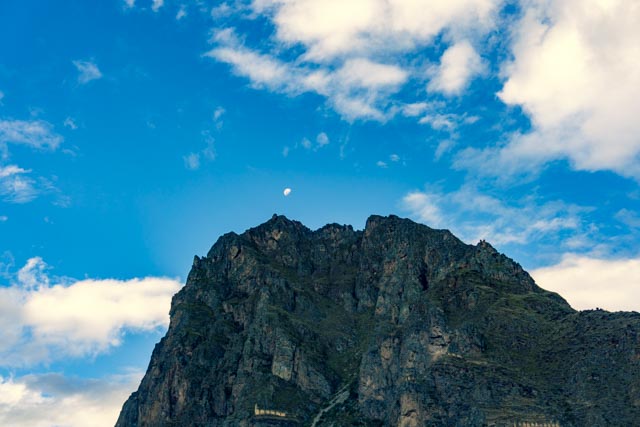
Below is a beautiful moonrise over the mountain at mid-afternoon.
This is the Templo del Aqua – Water Temple.
This trio sang us a tune before we boarded our bus. Cathy gave them $5 (she put it in the larger boy’s hat) and Vidal quickly removed the bill and took it to the nearest vender to make change. Apparently, the larger boy would keep the entire amount and sharing did not appear to be an option. Thanks to Vidal for making sure the money was evenly split. You can see Vidal in the background getting the bill broken.

 Travelling with the Schinglers