We spent the day in Kearny, Nebraska. Kearny is located between Grand Island and North Platte, off I-80.
In the morning, after making sure our resident sandpiper-type mother is okay with her eggs, we left for the Fort Kearny State Historical Park. Fort Kearny is located adjacent to the Platt River Road, the main thoroughfare for westbound pioneers and was established in 1848. It was the first fort built specifically to provide protection to travelers on the Oregon-California Trail. It also served as the home station to the (short-lived) Pony Express and was home to workmen building the first transcontinental railroad. The fort was no longer needed once the railroad was completed and was taken out of service in 1871.
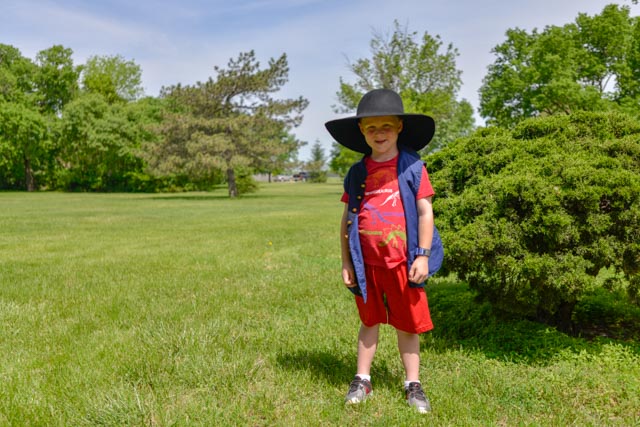
Jason with a “Hoss Cartwright” hat and period vest:
On the rear wheel of a US Calvary wagon. Jason burnt his rear on the iron wheel ring as it was already hot from the sun.

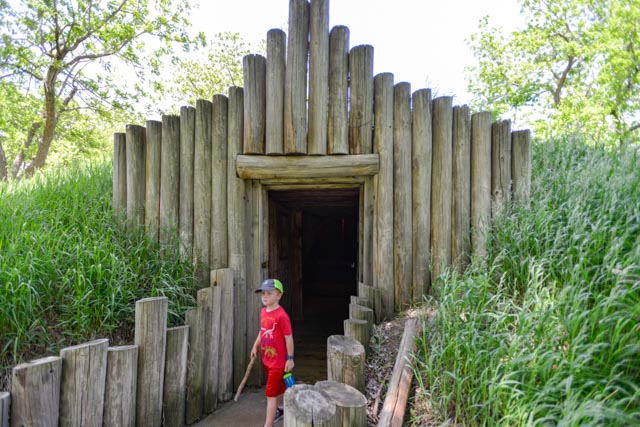
This is the blacksmith/carpenter shop, build with sod bricks and complete with a sod roof. It was actually much cooler inside!

There were several different guns in place near the parade grounds. This is the largest and the only one that was actually fired in war. Specifically, it is a “siege” gun manufactured in Boston and was used by the Union army in the Civil War.

Following an unmarked trail into the brush, we came upon this building, identified as the “Powder Magazine”. It was covered with several feet of earth and was heavily fortified. It was also cooler inside, but you probably would not want to be in there during a conflict. This fort was never attacked due to the visibility; you could see for miles in any direction originally.
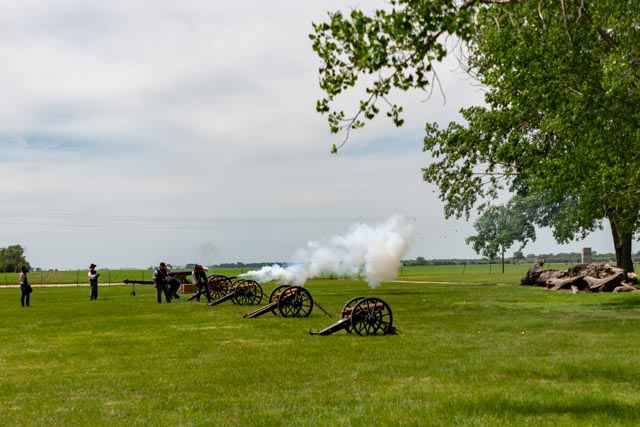
We came back for the Memorial Day cannon firing and all five guns were fired in order. Four of the guns were owned by the state and therefore had restrictions on the amount of gunpowder that can be used (4 ozs) for safety purposes. The operator personally owned the only “rifled” gun in the series so he personally doubled the gunpowder (to half a pound) for his gun shot (the fourth in these photos) Because of the rifled barrel, it has a range of 2,200 yards compared to the smoothbore gun’s 800 yard range. The fifth gun (the siege gun) misfired.
The first shot was from a smoothbore “compact” or “travel” gun, which was designed to be taken apart and hauled by mules or horses to obscure locations:

The next two smoothbore guns were designed to be pulled behind a team of horses to the support the battlefield:

This was the only “rifled” (and privately owned) gun in the display:
There was an encampment of re-enactors in period costumes and tents. These were their colors.

Immediately after the firing of the guns, we attended a short talk by a local historian and writer, complete with a slide show. The talk was centered on Nebraska (go figure) and the trials and tribulations of crossing it in the mid-nineteenth century. It was a good talk but Cathy and I both caught some discreet zzzs when the lights dimmed.
Our bird was still under our picnic table (which we moved to cover her and her eggs) when we returned to camp.

We will break camp in the morning and head to the famous town of Sidney, NE.

 Travelling with the Schinglers
Love the pictures
LikeLike