After leaving Mesa Verde, we headed to Durango. By the time we arrived, it was approaching darkness but the mountains were incredible, even by moonlight! We took highway 550 from Durango to Aztec, NM and spent the night in Bloomfield, about eight miles further down the road.
We left early in the morning and made the mandatory stop at Costco in Albuquerque to re-supply. We continued on, past the site of the Balloon Festival, and stopped for the night at the Bosque del Apache National Wildlife Refuge, near San Antonio, NM (just south of Socorro) ha ha. This RV site had room for four units, and there were already two others there before us. It was very, very small and hard to find. Our GPS sent us to the new school, then to the back of the school! We finally got turned around, scraped a few tires, rode a little on the new sidewalks and took the bus exit to get off the school grounds. I let my “internal” GPS take over, and by sheer luck found the place, about three miles from where our navigation thought it was.
The RV site was managed by a retired Sandia Labs engineer and he was very interesting to talk to. He showed us a micro model of a modern nuke that he machined for Sandia to test the stability fins in a wind tunnel. It was about a foot long and milled from solid metal . . aluminum(?). I asked him what tolerance he was required to adhere to during the milling process and he replied 1/10th and I made the assumption that was 1/10 of an inch. He corrected me . . . that was 1/10 in engineering terms, but actually 1/10,000th, less than the thickness of a human hair. We talked into the night and he and his wife invited us into their home where Cathy got to “test” a native NM wine produced by Tony Black, his friend who owns the nearby Black’s Smuggler Winery. We asked about the nearby VLA and he highly recommended that we make the 50 mile drive from Socorro to see it. He allowed us to leave our motor home at his place while we made the trip.
Cathy is using the Solar Radio Telescope, identical to the one that was used to track Voyager.

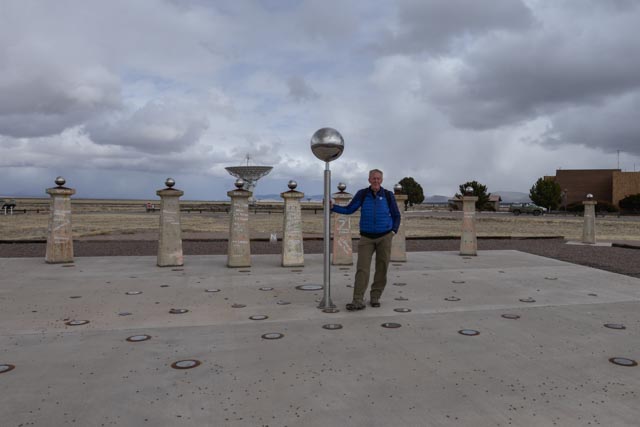
This is the Bracewell Radio Sundial. This sundial was originally built at Stanford and was later moved to this location. The concrete piers holding the globes behind me were the original foundations for the two radio telescopes from Stanford. He invited his “guests” to chisel (sign) their name onto the base and he accumulated more than 220 signatures, including Nobel Prize recipients, directors of observatories (radio and optical), and many pioneers of radio astronomy from around the world. The array was abandoned in 1980 and moved to this location in 2012 to become part of this sundial. Some Chinese, Russian and Greek astronomers have added their signatures recently. In terms of accuracy, maybe on par with the ancient one we saw and described in a recent Sedona post . . .
One of the 27 dish antennas, each 82 feet in diameter and weighs in at 230 tons. These are configured in a Y shape, and are movable to vary the focus. On our visit, they were in “D” configuration, with D being their widest span, about 22 miles. “A” configuration gives the most magnification and the array is very closely spaced. There is also a “B” and “C” configuration. As in photography, the best “picture” is derived from a composit of all four variations.

You can see the telescopes aligned in “D”. The two nearest are to the right of this picture.

It takes about two weeks to move the telescopes between configurations. There are two specially designed engines to move the units. They move directly under each one and while the unit is unbolted from its foundation, it is raised and move to a different foundation and re-attached. This process occurs four times yearly. Due to the extreme size, they cannot be moved if there is any significant wind. There are tracks parallel to each of the three legs of the “Y” and the engine has the ability to re-align its wheels 90 degrees to move the antennas in place via short “spur ” tracks.

We chose to do the walking tour first as weather was moving in, and by the time we were completed and ready to go to the museum, it began raining, then snowing. We were at an elevation in excess of 7,000 feet.

The antenna is bolted to its concrete footing.

This is the repair and updating building. The building is about ten stories high and the red engine that affects the movement is parked in front. It was blowing snow at the time we took this photograph.
Several, of many interesting facts about the Array:
- The super computer, the WIDAR Correlator, can perform 16 quadrillion calculations per second.
- This array can see clearly into the dust-shrouded center of our galaxy, 150 quadrillion miles, or 26,000 light years.
- This is the location of the movie “Contact” starring Jodie Foster and Matthew Mconaughey.
You can view a film about this facility, narrated by Jodie Foster at
public.nrao.edu/gallery/beyond-the-visible-vla
or take a guided tour:
public.nrao.edu/explorer/vla

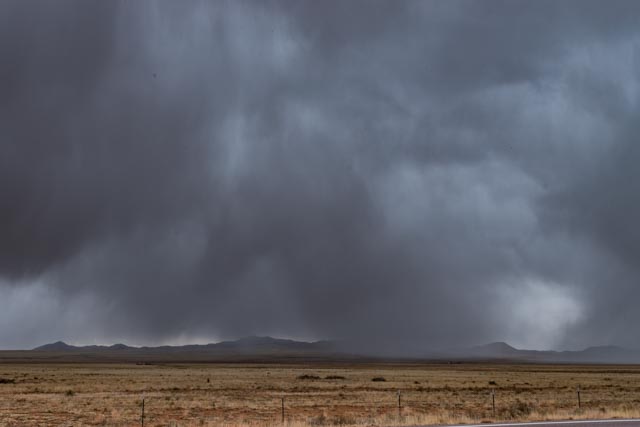
On the way back to San Antonio (NM) the sky really opened up, dumping several inches on snow on us before we made it to the pass.
Once over the pass, we made a side trip to the “Box”. We saw the signage “The Box” on the dirt/gravel road leading up a hill on the way out to the Array and decided to explore on the way back.

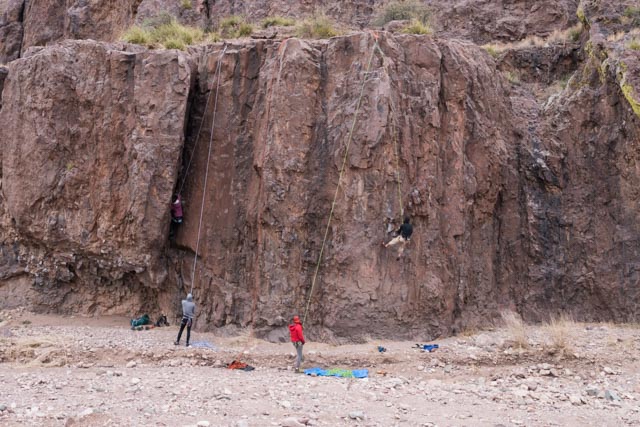
A canyon for rock climbers. There was a guide showing all of the routes up several of the cliff places in the canyon and a sign in sheet to complete (so they could find you if you fell?). There was an electronic counter to record the number of cars entering and the number of cars exiting the canyon. hmmm.

 Travelling with the Schinglers