We woke up this morning to rain and wind, but we knew that last night so we skipped our planned hike to Cathedral Rock and made the short trip to the V Bar V Heritage Site, which we have never visited due their limited hours of operation.
This is the fireplace from the original ranch house at the site.

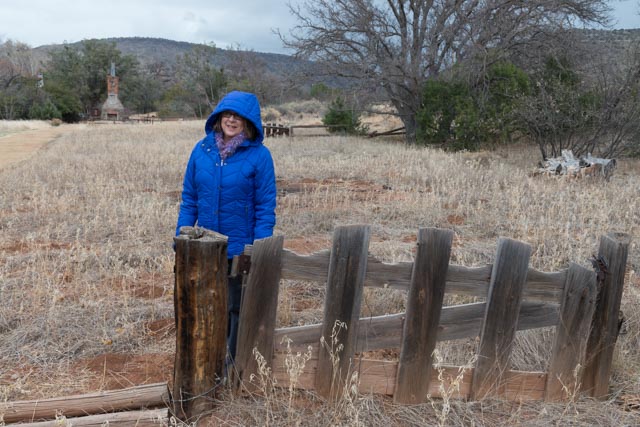
Cathy at one of the period gates leading to the petroglyphs.
The site, located in the Verde Valley, is the largest known petroglyph site in the area, with over 1,032 identified petroglyphs on 13 rock panels. The petroglyphs were created by Southern Sinagua residents between 1150 and 1400 AD. The highlight of this particular set of carvings is that it was used by prehistoric astrologers to mark the solstices and equinoxes. Basically, a pre-Columbian calendar, and a very accurate one at that! The site was known to early American settlers, and became part of the historic V-Bar-V ranch around 1907. The ranch headquarters were nearby, and the ranchers protected the site from vandalism. There are still some of the original ranch remains near the Visitor Center. The site was acquired by the US Forest Service in 1994 . It is protected and kept open to the public by the US Forest Service. Volunteers from the Verde Valley Archaeological Society and the Friends of the Forest provide interpretive tours and on-site management.
There is a mass of carvings on this center stone. The elements creating the calendar are partially visible in this photo. There are two stones in the upper portion of the large crack in the rock, a very thin, light-colored “map” stone in the center of the crack and a series of etchings on the face that create the calendar.
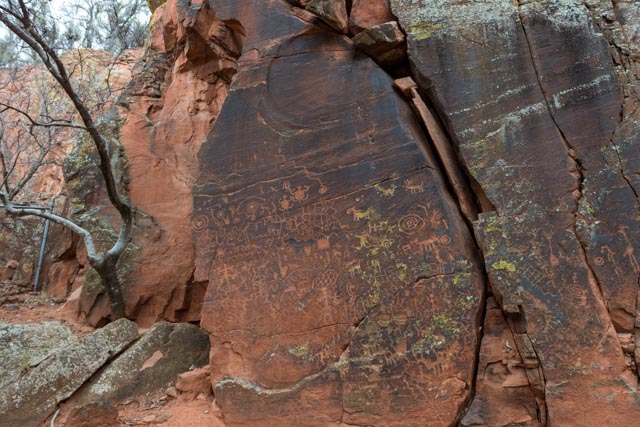
This is a close up of the two “aiming ” stones. It is interesting that these two stones are in their original position and were not placed by the Sinagua.
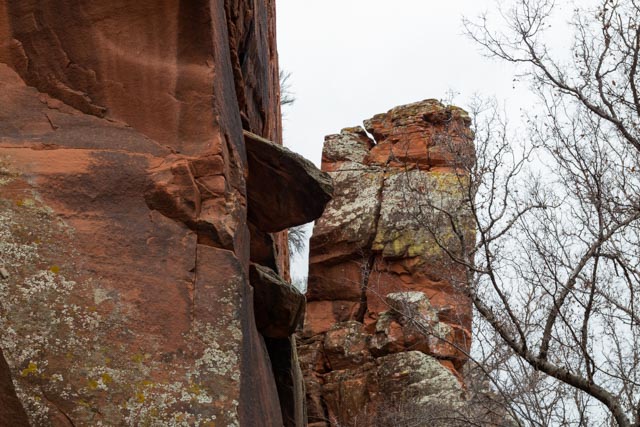
The lighter, thin stone was placed in the crack, as evidenced by the basalt stones holding it in place. Since the surrounding rock is all sedimentary, the basalt stones holding this rock in place indicates that the placement was done by the Sinagua. (Basalt is an igneous rock and not natural to this formation.)
Without going into the detail that our docent did, the center stone has been modified, similar to an arrowhead with chips that appear to be random, but upon study, depict the skyline of the San Francisco range of mountains near Flagstaff, which is where the Sinagua believe the spirits reside. This outline of the mountain range is projected on the side of the stone to the left of the center stone, with the sunlight coming in from the right, through the large split shown in the previous photo. You cannot see the San Francisco range from anywhere near this point so it is pretty amazing that they could have done this hundreds of years ago.
Some of the details of this calendar:
The stepped line in the top center exactly follows the shadows of the seasons. The line ends with a jagged line representing lighting, which occurs in the third quarter in this area and ends with a counter-clockwise circling event, which probably represents the storms that follow the lightning, which alway enter this regions from the south and circle, you guessed it, counter-clockwise.
The three large concentric circular carvings represent the exact dates as detailed below:
- The left concentric circular carving marks both the spring and fall equinox.
- The center concentric carving marks the summer solstice.
- The right concentric carving marks the winter solstice.
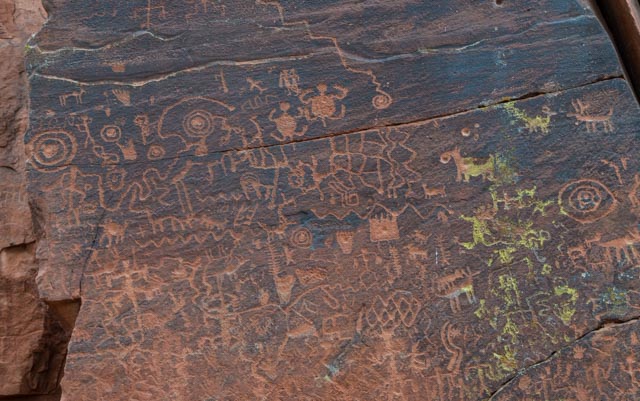
The very knowledgable docent that we met has verified that these markings are very accurate, coinciding exactly with the appropriate dates.
There are additional carvings on this panel to signal when to prepare the fields for planting corn, with three different/staggered planting dates, to maximize the crops.
There are many more markings, including a plat of the area (the checkered drawing upper center) with the adjacent river shown as squiggly lines, a dancer with an asterisk (lower right) that indicates when the spirits return to the mountains, actually so much information that I will be purchasing the book “Sinagua Sunwatchers: An Archaeoastronomy Survey of the Sacred Mountain Basin” by Ken Zoll. Ken spent several years documenting his findings and the accuracy of this pre-historic calendar while being a docent on this site and is now the executive director of the Verde Valley Archaeological Society. We have been visiting these Sinagua sites now for three trips and cannot be more impressed with their knowledge. They were definitely not inferior to their European or Western counterparts.
We met some “free range” hamburger on the hike through the brush, near the ranch.

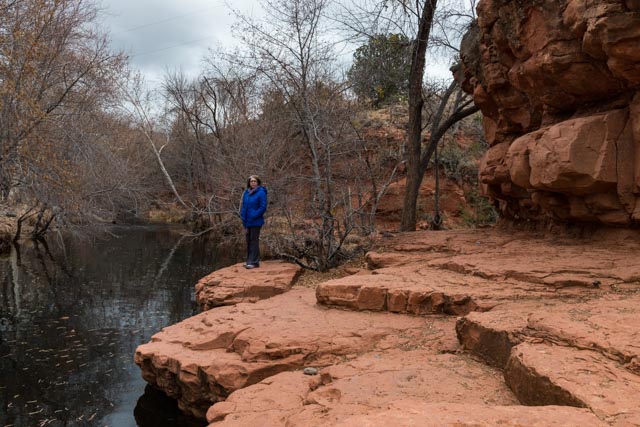
On our way back to camp, we spotted this pool from the single lane bridge and dirt road above, so we pulled over, walked back to verify then trekked down to the water. While we were there we saw a pretty good-sized trout jump out of the water so I went back to the truck to get some crackers to feed them. They didn’t respond well to the crackers.

 Travelling with the Schinglers