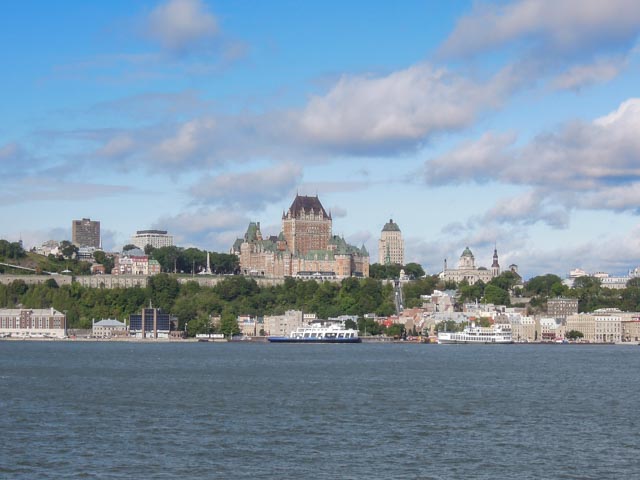
We took a shuttle (provided by our campground) to the ferry boarding area and made the ten minute trip across the river, docking in/near Old Town Quebec. This is what we saw from the embarkation point.
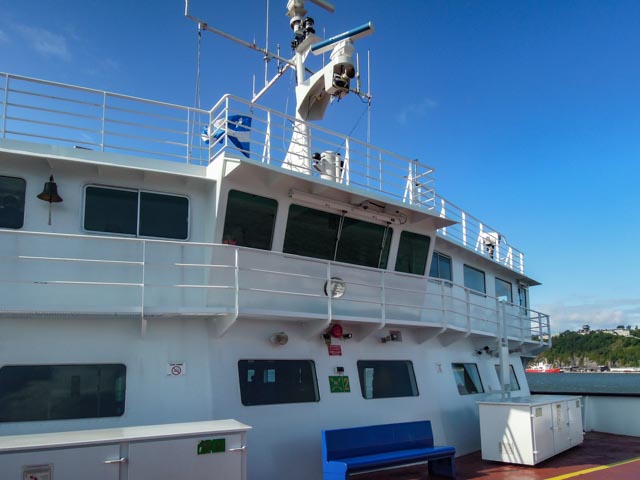
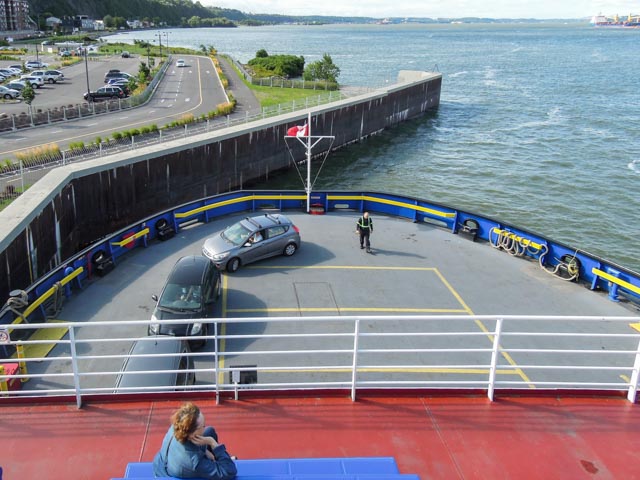
The ferry was in pristine shape, very clean and modern.
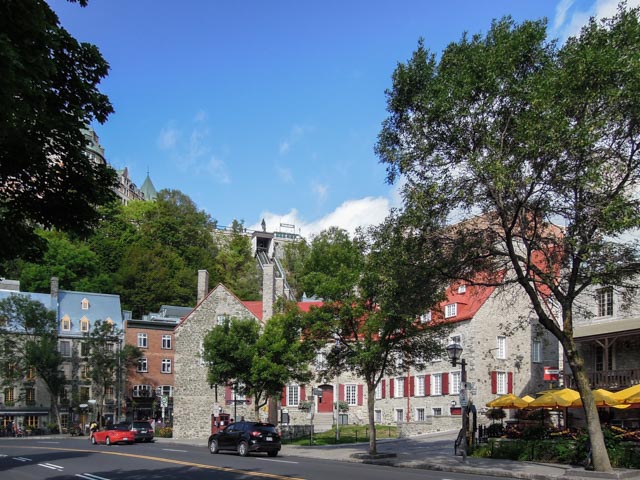
After arriving in Old Town, this is the first scene we saw. By the time we left, seven hours later, it was mayhem here, crowded with tourists.
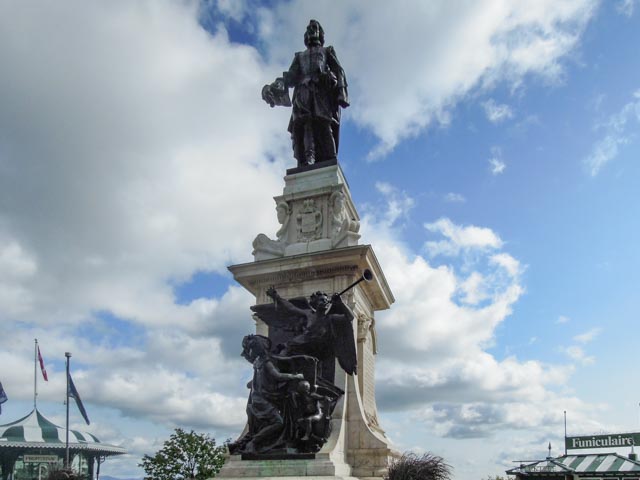
This is a Statue of Champlain, the founder of Quebec. The face on the statue is actually that of the King’s accountant as there was no existing drawing/painting of what Champlain actually looked like. The accountant was of the same age.
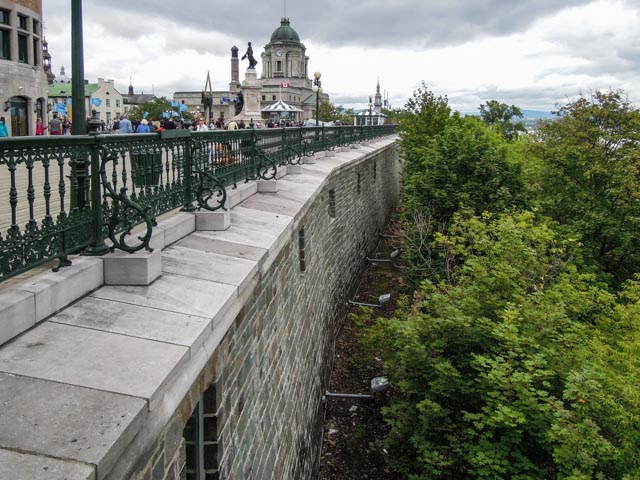
The wall surrounding the old city. There were many gun placements and batteries along this very thick and substantial wall. You can see the Champlain statue in the background. The Fairmont Hotel is to my left. Quebec is the only remaining fortified city in North America, north of Mexico. These walls were originally built by the French and refortified by the English after they took Quebec City in the Battle of the Plains of Abraham in 1759.
Here are random shots of the Old City. The streets were very narrow in places and we were glad to have taken the ferry there. Parking is difficult if not non-existent. We walked miles through the streets in our seven hours. We did take a walking tour as the bus tours cannot get down some of the streets and alleys. We are planning on going back Monday to spend another day, seeing some items we spotted today; including the changing of the guard ceremony at the Citadel, and the antiques section of the lower city, and of course, a museum or two.
Interesting placement, City Hall, the seat of local government directly across the plaza from the Catholic Church. We were told this is typical in European French cities. “The “Hall of the people facing the Hall of God”.
We did not go into City Hall, but did make our way into the church, the Notre-Dame de Quebec. The interior was massive, with many alcoves with prayer rooms, alters, etc. Francois De Laval (1623-1708) is entombed within the church. Francois, at age 59 became the first Roman Catholic Bishop of Quebec, appointed by Pope Alexander VII. He was beatified by Pope John Paul II in 1980. He was granted “equipollent canonization” on April 3rd, 2014 by Pope Francis.
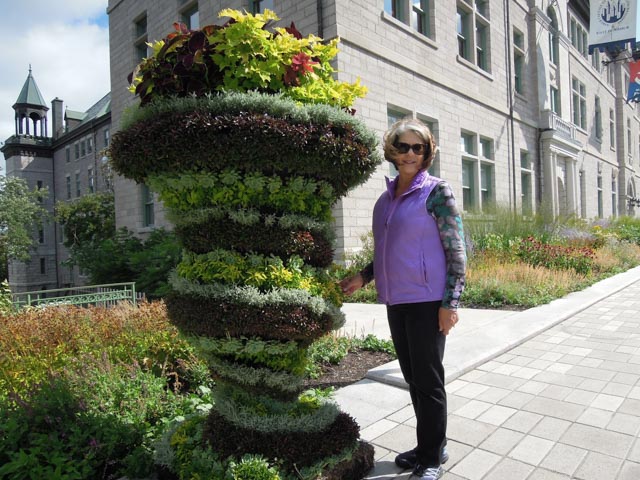
There were several of these massive floral arrangements near parks and churches within the walled city.

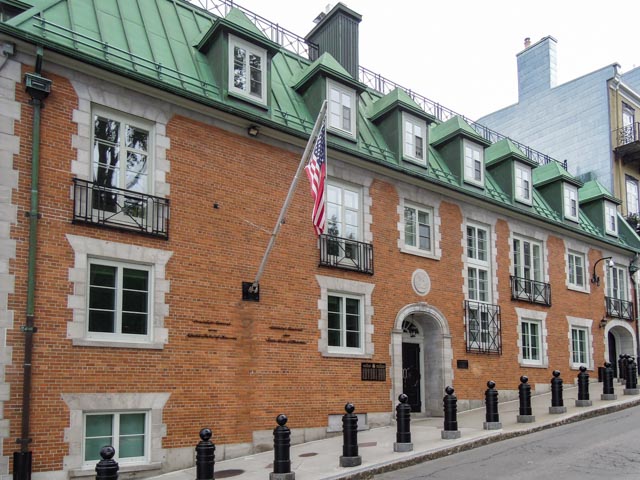
This is the U.S. Consulate General, located within the Quebec City Consular District.
We stopped for lunch at D’Orsay Pub on Rue de Buade. Cathy and I had a discussion on whether it was an English or French Pub. The very prominent display of a painting of Sir Winston Churchill sealed it for me…it was an English Pub, but after asking, it is referred to as an “European Pub”. oh well . . . .

Cathy going over the desert menu. How about a cake with (Canadian) maple syrup and yellow cherrys? There is enough maple syrup, sugar, creme and butter in it to keep you going for a long time. It was called “Poor Man’s Pudding” or pudding des pauvres hommes. I went out of a limb and had Fish and Chips . . .


This is the statue of Elzear-Alexandre Taschereau (1820-1898), the first Canadian-born Cardinal of the Roman Catholic church. He served as Archbishop of Quebec from 1871 until his death in 1898. The first Canadian cardinal, he was elevated to the College of Cardinals by Pope Leo XIII in 1886. That is our restaurant in the background, City Hall is on my right and the Notre Dame Church is on my left.

This is the Fairmont Le Chateau Frontenac Hotel, where Churchill and Roosevelt held clandestine meetings planning the Normandy invasion. The entire hotel, more than 600 rooms were vacated without prior notice (do to the secrecy of the meetings) and was occupied by members of the military during the meetings. After one meeting, Churchill (it couldn’t have been Roosevelt!) left notes of the invasion on the table. A waiter picked them up, read them, then turned them in to the military commander. Because he kept what he had found a secret (unlike today), he was awarded Canada’s highest medal of honor after the war.
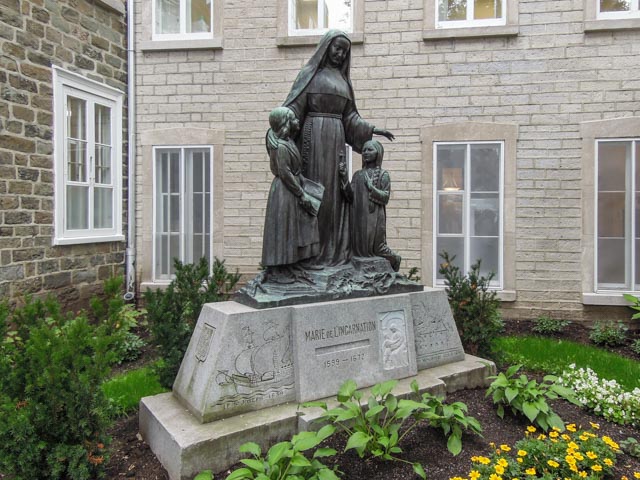
This is a statue of Marie de L’Incarnation (1599-1672), an Ursuline nun of the French order, who is credited with founding the first girl’s school in the New World. It is located in the original courtyard of the school, dating to the early 1600’s. The school is still in existence but has moved to the suburbs and now has about 40,000 students. It is no longer a women’s only institution. She was canonized by Pope Francis in 2014 and is entombed in the sanctuary of the church for this school. The Anglican Church of Canada celebrates her with a feast day. There are two stained glass windows in the tomb, both of her

After visiting the first women’s only school, we had to go to the original men’s school, Cour interieure du Petit Seminaire de Quebec, which is also still in existence and operates in its original buildings. We are going through the gates and archway into the center of the courtyard. The building to the right of the tree is part of the Notre-Dame de Quebec facility.

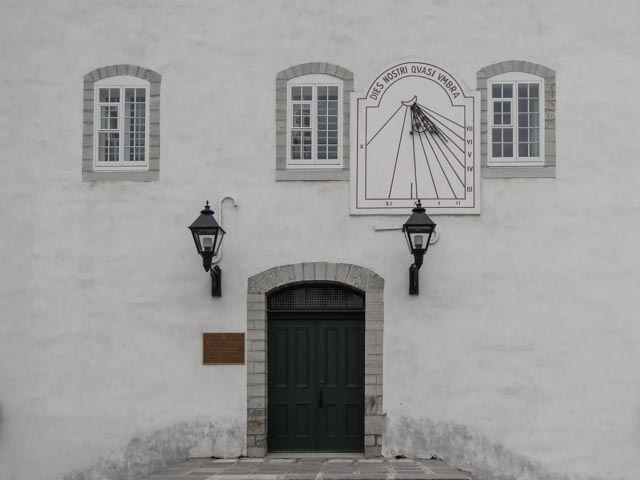
This sundial, located above a door to the dormitories and in the courtyard of the school, was installed in the 1600’s and is till working, although it cannot adjust for daylight savings time. The students came to this school for religious based education through about the 12th grade and lived here in these massive dorms. There were several original winch assemblies still attached to the windows to assist them in getting their luggage up to their rooms, some as high as three stories. I have tried several translation sites but cannot find the meaning of the verbiage above the sundial . . .
The dark tiles on this street represent the banks of the St. Lawrence river, the first one was where the river was in 1600, the second one was where the river was in 1700 and the one at the foot of the street was where the river was in, you guessed it, 1800. You can see the cruise line debarkation ramp beyond the tour bus on the current river front. No, the river changes are not due to climate change, but landfill to enlarge the port area. Landfill in the river is now prohibited by Canadian Government.

One last look at the city before we left, including the massive hotel on the hill and the cable driven funiculaire leading from the lower city to the upper city, within the walls. The funiculaire was originally installed to get supplies from the docks to the upper city but now ser es as a tourist attraction. At $3.00 CDN, it was well worth it, saving about 400 steps. It was late in the day and very crowded, Monday’s visit will start several hours earlier than this one today.

 Travelling with the Schinglers