I started out the day with a morning run on the incredible trails system here in Nova Scotia. I ran from the campsite, about a mile to the trailhead of the “Dynamite Trail” section of the “Rum Runners Trail”. There were very few people on the trail; a couple of walkers and a couple of bikers over the entire 12 mile distance covered. I did see a lot of beaver activity and deer stealing apples from an orchard. I also saw a pretty big trout going into one of the many trailside lakes. I made it from Martins River to Mahone Bay before turning back.

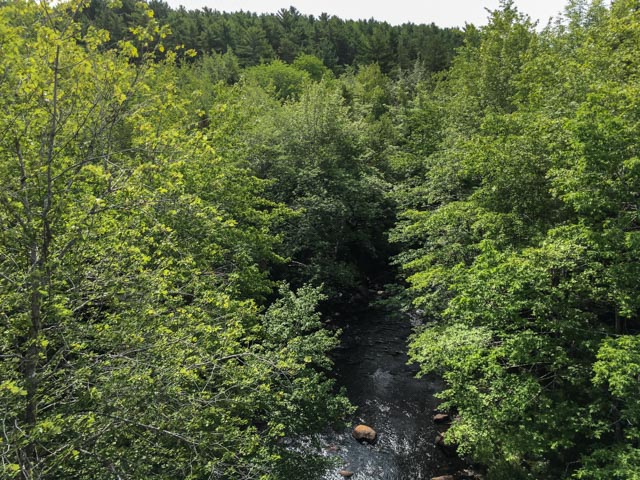
This is one of the bridges crossing a pretty deep gorge with a river at the bottom…

In the early afternoon, we headed to Peggy’s Cove, between Martins River and Halifax. We stopped at the Swissair Flight 111 Memorial. Flight 111 was a scheduled flight from New York to Geneva but was redirected to Halifax due to an onboard fire and went down about 8 km from Peggy’s Cove, killing all 229 passengers.

This is the lighthouse at Peggy’s Cove, as seen from the memorial. The rocks in this area were once covered by a glacier almost 3,400 feet thick. By comparison, that is about 44 times the height of this lighthouse. The glacier stretched all the way from the arctic and was here as recent as 10,000 years ago. You can see the deep gouges in the rock caused by glacial movement and the round(ish) rocks were left behind as the ice melted.

We parked at the visiter’s center and walked into the cove. These are some photos of the area approaching the lighthouse. The tide was outgoing and some of this area was high and dry when we left.
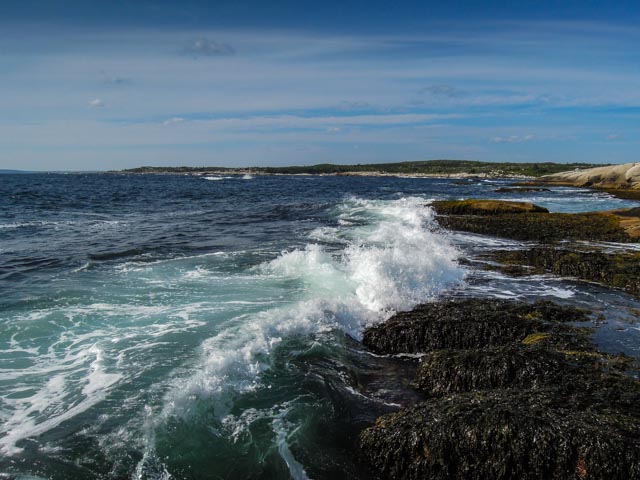
We disobeyed the many warnings and went down to the “black” rocks to watch the waves.

Next stop was Halifax, the largest town in NS.

We visited the Citadel, a star-shaped fort built to protect Halifax from a land-based attack. It was completed in 1856 and was the centerpiece of an extensive series of fortifications built by the British military starting in 1749 to protect the strategic port at Halifax. The port at Halifax became one of the four principal naval bases of the British Empire and was garrisoned by British until 1906, when the Canadian military assumed control of Halifax’s defenses.
One of the exhibits we saw was a WWI trench warfare recreation, complete with periscope devices to safely view the enemy. There were many guides, all dressed in period clothing explaining the fortifications and the differences between American, Canadian and German construction of the trench systems. We also saw period gas masks, aid stations, medical equipment and officer’s quarters.
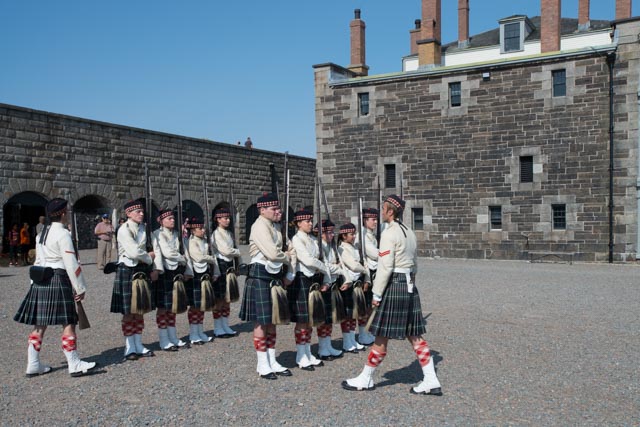
On the extensive parade grounds within the fort we witnessed bagpipers and drill units…

This gentleman was explaining how Henry Ford designed this ambulance and included some neat side stories about how he worked with his supplies to help (unknowingly) supply some of the parts to keep his profits up. These vehicles were shipped to the front in a crate, fueled and ready to go.

This is one on the mess halls inside the fort…

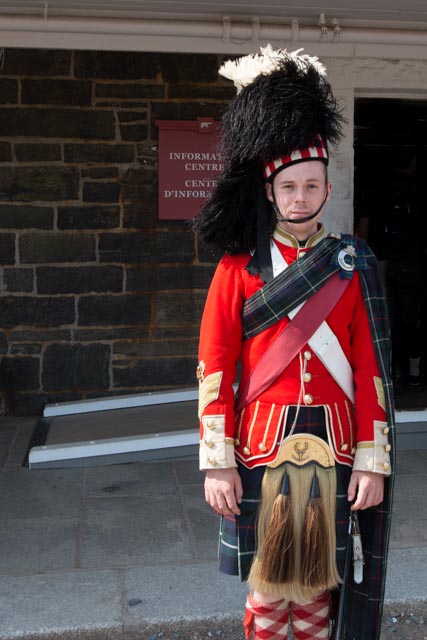
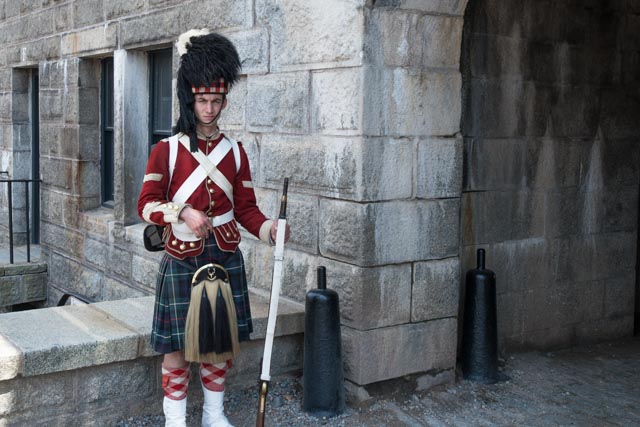
Below is one of the many uniformed personnel who helped explain the working of the fort. Canada does an excellent job of providing knowledgable people in these positions. There was a very thourough military museum on the second floor of the barracks. We spent a lot of time in the museum, but would need an extra day just read and experience all of the information.
As we walked the walls, it became clear how large this fortification was. The white tent at the far end of the yard is to the right of the Ford Ambulance. To the right of the tent is the entrance to the trench warfare area…


A cannon is fired every day at precisely 12:00 noon…

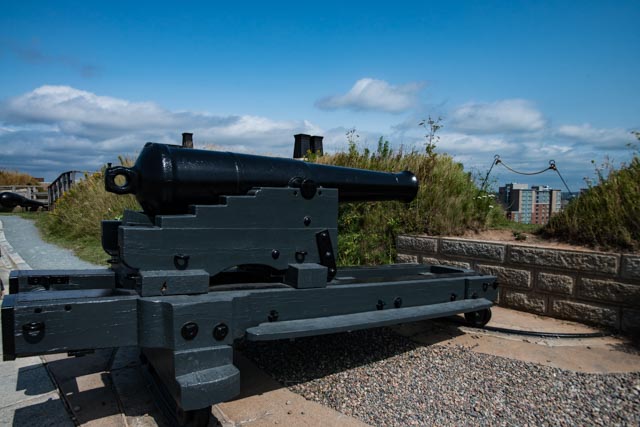
This is one of the 30 pounders in place (and the cannon view) to protect the area. This may be the “original” grassy knoll. It is overlooking the Hockey rink.

This guard is positioned at the inside wall exit of the fort. There was another guard at the outside wall exit.
There were two walls built, an inner and an outer wall to absorb shock…

We took the scenic route back from Halifax and stopped a couple of times to take in the scenery. There were lots of these glacier carved lakes and ocean inlets along the way.

 Travelling with the Schinglers