I managed to get in a run while in Tolland. Dana took me to the Vernon trailhead of the Rails to Trails/Hop River State Park Trial the previous evening and I marked it on my GPS so I could find the start point in the morning. It was a great trail, in a series of trails in the area. I felt good early on, so extended my run to a little over 10 miles, going under the interstate via this tunnel. I managed to run to the next town, the site of the original, ca1850 Bolton station of the Hartford, Providence & Fishkill Railroad.
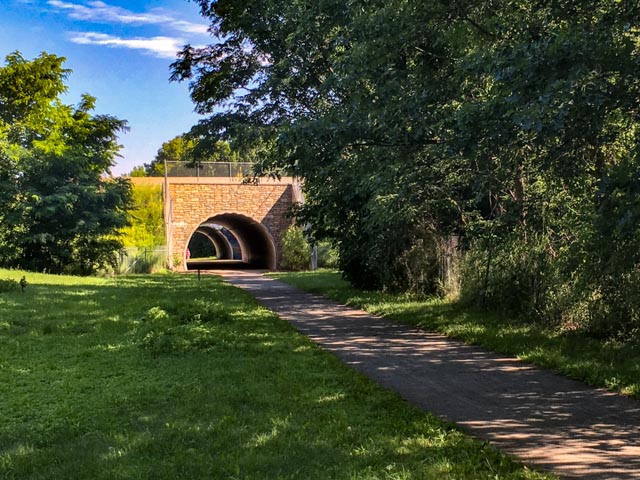
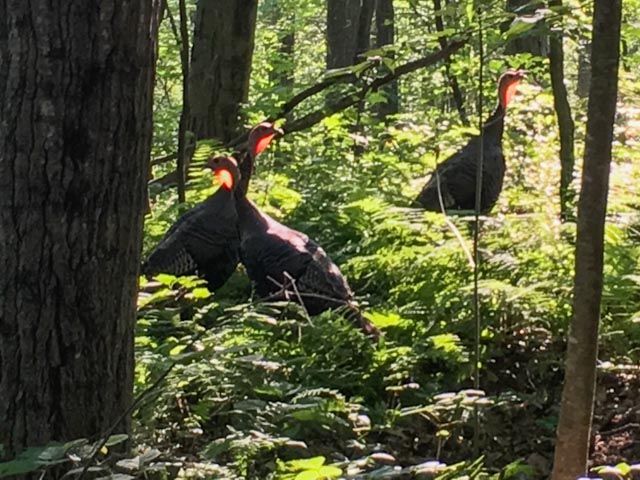
The trail had a long, steady climb for the first 5 miles but was shady and provided some great scenery. I had to stop for the group of wild turkeys to cross the path at one time. Turkeys really do fly . . . one almost hit an approaching runner as it was airborne crossing the path in front of us. Early, when I started, I was alone but a couple of hours later the trail traffic had picked up substantially. I did pass a running group starting their daily run and several individual runners/walkers and bike riders.
There were some narrow rock cuts through the granite and flowing water with several small waterfalls alongside the trail near the turnaround. It had rained the evening before and there was a little water covering the path near a stream restoration project at the upper turnaround. The original utility (telegraph/telephone) poles were still in place and railroad ties were embedded on the roadbed at several places.


On Thursday, we made the journey to historic Old Sturbridge Village, located in Southern Massachusetts. The village is a smaller version of Henry Ford’s “Greenfield Village” located in Dearborn, MI. The most significant difference is that most of these buildings were sourced locally.
Our first stop was naturally at the glass exhibit. There were multiple glass works in the late 18th and early 19 century in the area. There is a pretty good exhibit with various forms of glass, from table glass to “industrial” glass to vessels and vials to decanters, pressed glass, blown glass, etc. We spent more than the usual time in the building because there was a summer squall passing by and it was pretty wet for a while outside.
Next we viewed a beehive, complete with real honey bees swirling about, then moved to down the street to watch a costumed worker working with an ox.

This is a view looking at the Fitch House & Barn, the Fenno House and the Fenno Barn (foreground) as seen from the “Friends Meetinghouse”.

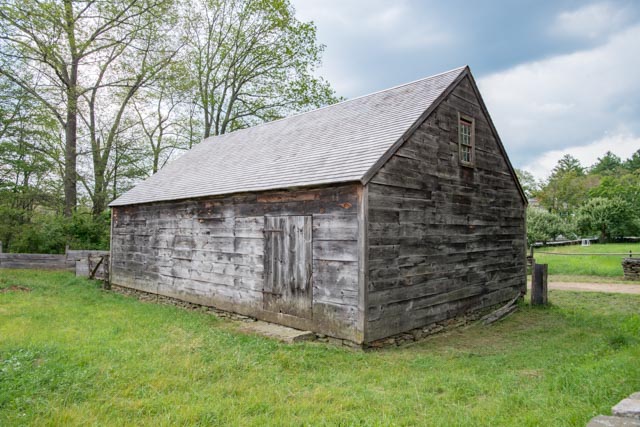
This is just a random barn, early 18th century of course…
A view from the town square, with the Town House at one end of the (rectangular) square and the Center Meetinghouse (with steeple) at the other end…
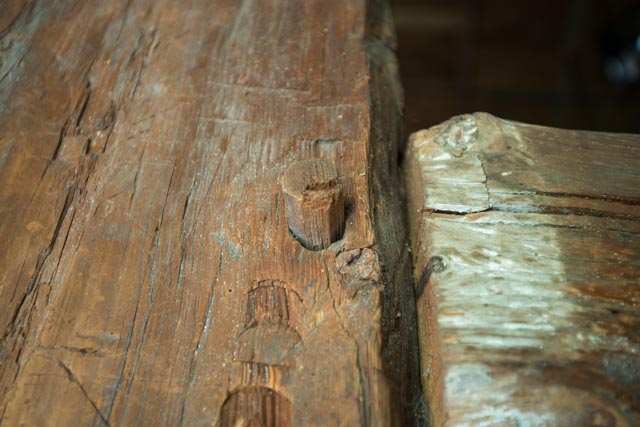
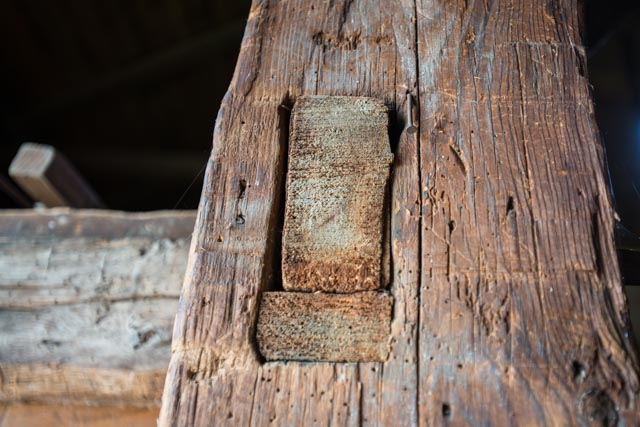
Joinery found in the Parsonage barn, incredible workmanship…
- The top photo is a very large support beam that had about 1/4th of the end fitted and pegged into a rectangular slot in the upright post.
- The second photo is an example of two intersecting beams held together using pegs, or large dowels.
- The third photo is an example of large-scale mortise joinery.
All of this was in a barn! No wonder why these structures have been around for more than 200 years!

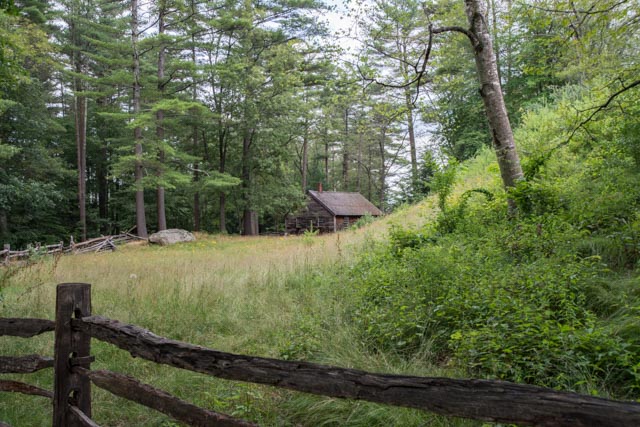
A small house in the woods…
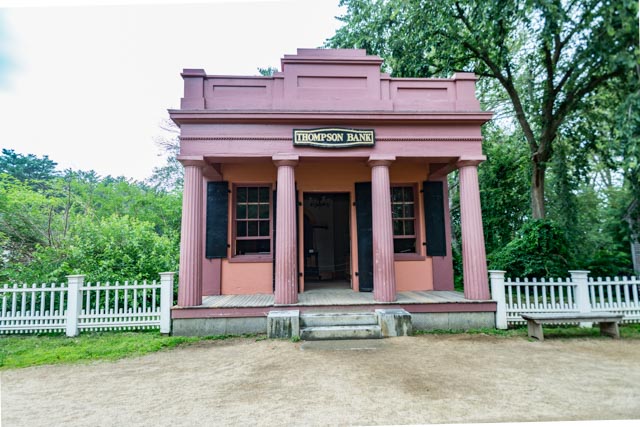
The Thompson Bank, ca 1835 moved from nearby Thompson, CT. Banks were purposely designed to look stout to give a sense of security to the potential clients.
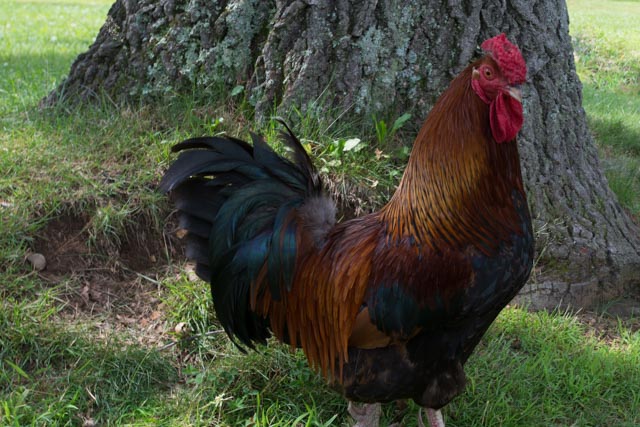
This may be a lost Gamecock(?)…
On the way out, we saw what may have been an early example of farm laborers tilling the soil in a cornfield

Later, back in Tolland, CT, I had to take a shot of this late 18th century home and barn.
Tolland is literally surrounded by pre-Declaration history and multiple (15) recorded glass works operating between the late 1700s and the early 1900s. Most of the towns that we passed between the RV Park and Tolland were founded in the very early 1700s. We could spend a lot of time here exploring the sites, visiting the family, and walking the trails.

 Travelling with the Schinglers