We arrived in Benson in the early afternoon after a short day of driving. We selected this site because they have a planetarium that the guests can enjoy. We spent a couple of hours in freezing temperatures inside the facility observing, with 11 other brave souls, several stars including Beetlegeuse (which is a prematurely dying superstar) and, for comparison, a (relatively) new blue star. In addition, we observed Venus, Mars, a star cluster with billions of stars that was about 7,000 light years away (light travels at about 5.6 billion miles/year, don’t want to do the math) and a nebula in the Orion cluster. The observatory houses a computer driven 16 inch Schmidt Cassegrain scope built by Meade.

The observatory:

After leaving Benson, we took the scenic route to Tuscon, via Nogales. We traveled south of the snow-capped Santa Rita range, going through several small towns, including the town of Patagonia, which was an artist enclave. Once we arrived in Nogales, I took the motor home downtown to see the border. I turned when I saw flashing red lights, and found out I was lucky, the lights were the Mexican border and I DID NOT want to take the motor home into Mexico.

Heading north to Tucson, we travelled on the other side of the Santa Rita range. The north side did not have any snow remaining as it faces the sun in the afternoon. We did stop at the Tumacacori National Historical Park and spent some time walking the facility.

This church was founded by the Spanish in 1691. This facility was originally designed to have a barrel domed roof in the sanctuary and two niches on the sides to hold statuary but lack of funds forced the Franciscans to scale back twice, eliminating the niches and the vaulted roof. The bell tower’s domed roof was never completed.

This structure was designed to be a chapel in the graveyard but again, funding ran out, the domed roof was never finished. The holes in the sides were for wood posts to hold the scaffolding to be used to construct the dome.

A photo of the graveyard, behind the sanctuary. The holes on the wall were for the 14 stations of the cross.

This “elaborate” facility was the convent:

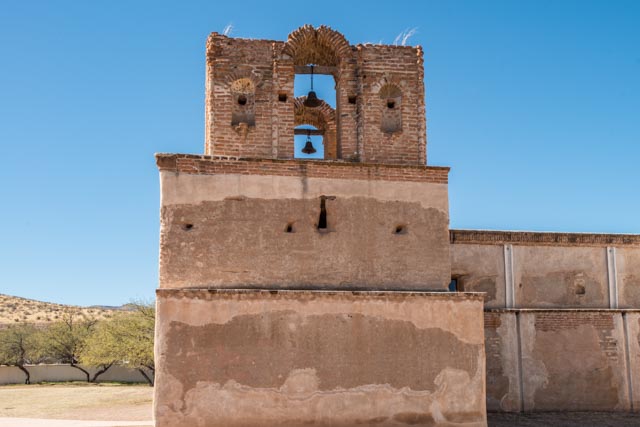
A side view of the never completed bell tower:
Cisterns, designed for the storage of rainwater at the front of the church:

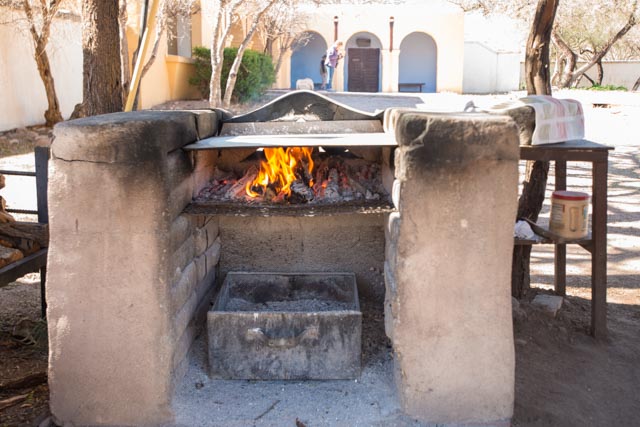
Cathy discovered a hispanic lady making corn tortillas by hand. She had to have a couple and I broke down and had one also.

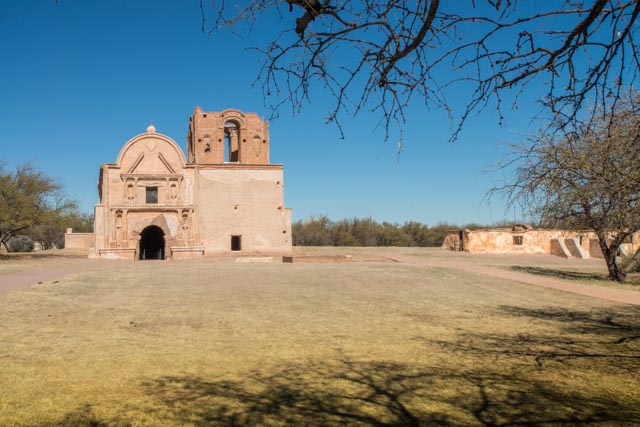
A parting shot of Tumacacori and the convent. In 1821, Spain ceded the land to Mexico and the construction at the church ceased. Mexico forced Spanish-born residents out of the country and the church became vulnerable to attack. The Mexican War cut the supply lines and the Apache increased their attacks, then the winter was extremely cold, forcing the closure of this church in 1848. It became US property via the Gadsden Purchase in 1853 and fell into disrepair. Teddy Roosevelt visited the facility in the early 20th century and declared the church a Federal Historical Site, thus preserving it in arrested decay.
Nearing Tucson, we stopped at the Titan Missile Museum and site. This is the only complete site left (with the Titan III missile in the silo but sans the real warhead).

We went down into the facility through a series of 6,000 pound blast doors:

This is the main control room for the facility. There are chairs for two persons as it takes two simultaneous key actions to activate a launch. The gentleman in the blue shirt is a retire USAF Colonel and was very familiar with the activity at this station. He went through a launch sequence with all the bells and warnings. Please note the giant green spring to the left of the console. The entire facility is held on springs and shock absorbers to help it weather a direct hit by a thermonuclear missile. Also, on the 27 bay computer cabinet on the right, the blank slots originally had computer hardware but during the 20 plus years of this facility, these were updated and only two slots on the center cabinet were being used.

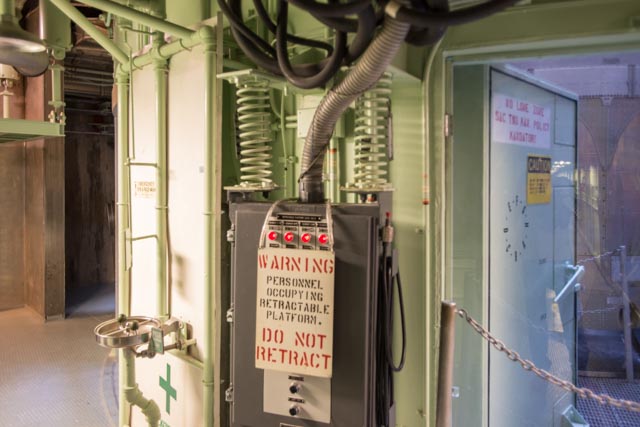
This is an electrical panel attached to the wall of the silo. It is suspended to keep it from coming apart at launch.
These are just a couple of the redundant communications antenna. The unit on the right is hardened and redundant. One is above ground while the second one is underground in a hardened shaft for backup.

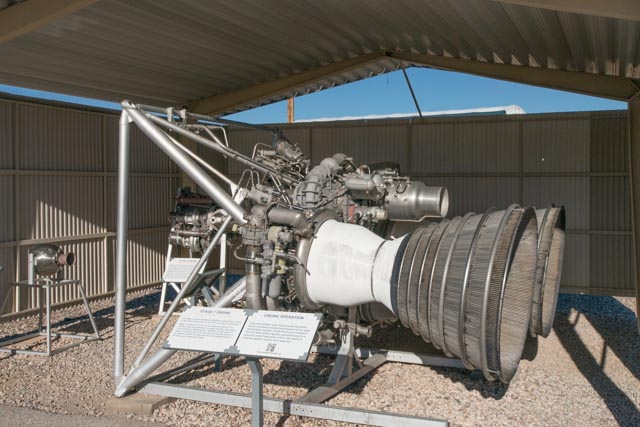
This is the Titan III two nozzle rocket engine. It produced 430,000 lbs of thrust, the equivalent of two 747s at full throttle. Titan III powered the original Mercury space missions including those of John Glenn. These engines burned for 2.5 minutes and used 25,000 gallons of propellant.
This is a HDR 5 photograph composite shot looking down into the launch tube. The missle is 110 feet high. In the full pixel original, you can see objects on the floor at the base of the missle. I was told that the entire tube would be destroyed during an actual launch. The panels on the sides of the tube are sound deadeners, as the extreme noise of the rocket engines in the silos would destroy the missle if unabated. It addition, thousands of gallons of water and steam were piped into the tube during a launch to mitigate the sound. Apparently, as loud as it was, it could not be heard or felt in the control room, only a hundred feet away.


 Travelling with the Schinglers