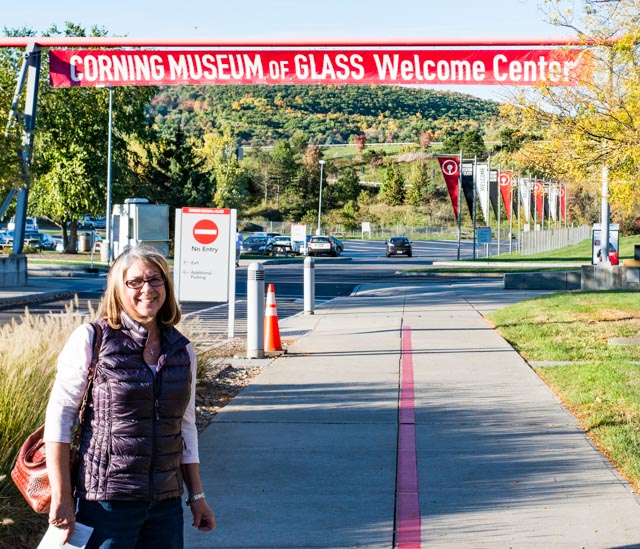
We left Detroit, with a planned goal of reaching Gettysburg by day’s end. We (I) forgot all about the Corning Museum of Glass until we passed the first highway sign with Corning – 150 miles. We had to stop as this is one of my “must see” museums. I do feel kind of dumb that I didn’t realize this was THE Corning, of glassmaking fame . . .
Found room for the rig at the back of the lot . .

After we entered the facility, we decided to go directly to the Historical exhibits. I will list some of my favorites below. It is amazing the skill of glassworkers and the elegance of their work, some dating from more than 7 centuries BC. I will not play historian but will simply list some of the ancient work:
- Egypt, 4th Century BC

- Egypt 4th Century BC

- Egypt, 4th Century BC (Amber glass head)
- Egypt late 4th Century BC (Ptolemaic plaques and inlays, white/blue glass)
- Greek, 1st Century AD (inscription: “Rejoice and be merry”)

- Bottle with Jewish symbols, late 6th-early 7th century AD

- Roman, 1st Century AD, signed by master glassworker Ennion

- Roman, 1st Century AD, signed by master glassworker Ennion
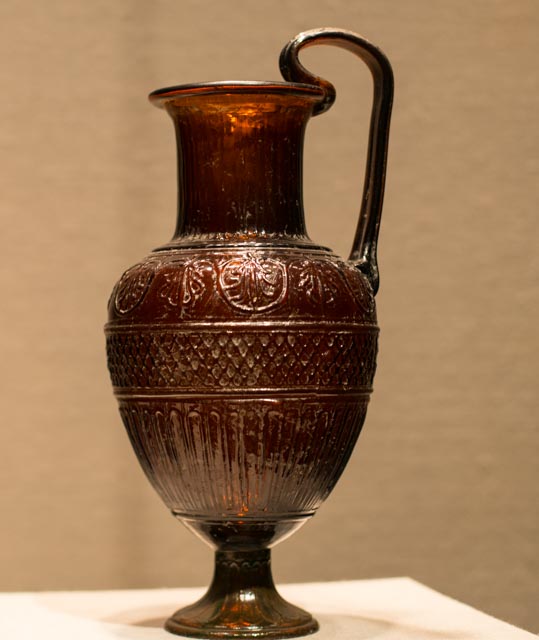
- Roman, 1st Century AD (This cup is embossed with Gladiators!)

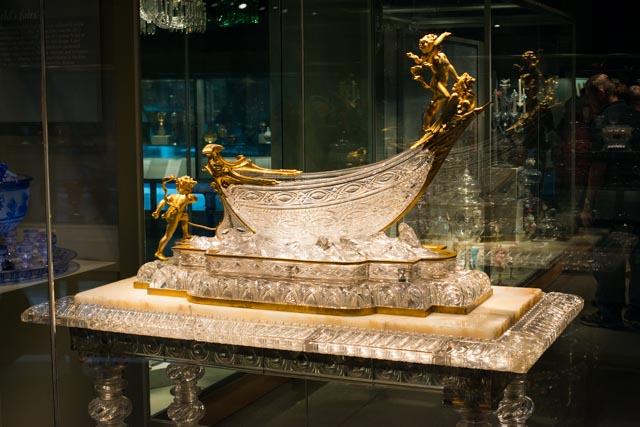
- Baccarat crystal table, one of two manufactured for World’s Fair. The late Liberace possessed the twin.
Now American glass, something I am more familiar with . . .
This is a Tippecanoe flask, made for the 1840 William Henry Harrison presidential campaign. This bottle is worth in excess of $175,000 and is in a cluster of very common bottles. It is one of two known examples. Most of the bottles and glass pictured in the next six slides were part of a collection gifted to Corning. Apparently, they assumed they were just everyday flasks/bottles and grouped them in very crowded cabinets for display, with absolutely no information other than they were American blown bottles . . . .

This is the holy grail of American blown bottles. It is a pint Charter Oak in cobalt blue. It is unique in that it is the only Charter Oak in blue and the only Charter Oak in pint size. All other Charter Oak flasks are half pints are found in aqua, amber and lighter shades of green. It is probably worth in excess of $200,000 if it became available for sale. As you can see, it too is buried amongst very common bottles.
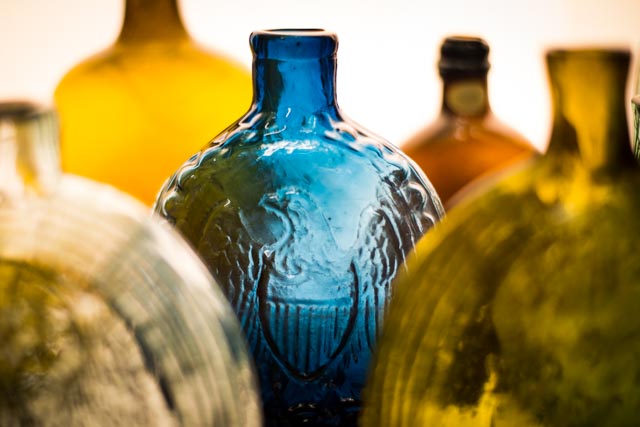
This is probably the only clear to amethyst American System flask in existence. The American System was campaigned by Henry Clay in the early 19th century. The more common aqua version of this mold sold in 2012 for more than $30,000.

This is a pint cobalt blue Columbia flask and next to it is a Jared Spencer Flask (made in Connecticut). Each of these flasks are very rare and would bring about $100,000 if offered for sale.
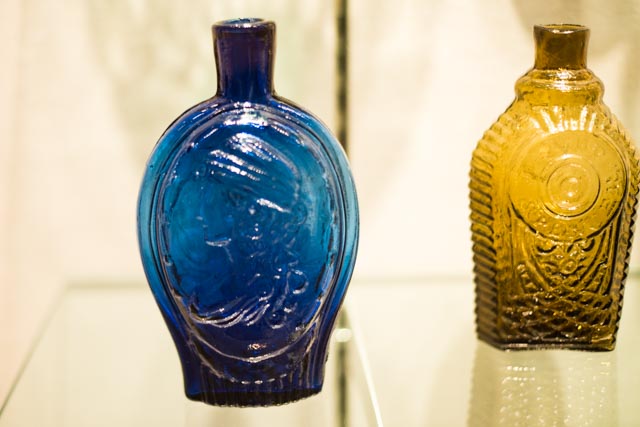
This is the “more common” of the Tippecanoe flasks (about six known, two or three undamaged). It would bring well over $100,000 if offered for sale . . . .

I did see the very top of, and the very bottom of a blue flask, buried six deep in one cabinet. The bottle in the very back, virtually unidentifiable to most, is what’s known as a “Firecracker” flask, in cobalt blue! This particular flask was blown by the T.W. Dyott Glassworks in 1826, to memorialize the deaths of John Adams and Thomas Jefferson, who both passed on July 4th, 1826, exactly 50 years to the day, after signing the Declaration of Independence. Wow! Value: at least $100,000. (Sorry, there was not enough visible of this bottle to photograph)
Painting with glass. This was a new concept to me but it apparently has been in use for some time. These are “paintings” made of glass, which when backlit, appear as shown. There is no “paint” on these, everything you see is glass, one piece of glass. It really takes an artist to be able to produce artwork such as these. They are unbelievable!


These are more traditional “stained glass” windows, made from individual pieces of glass joined with lead. The one on the left is from Tiffany, the one on the right is of St. Matthew (San Mateo). Our Catholic Church in Winder is St. Matthew . . . .


These next few slides are from the more modern exhibits within the museum. I normally shy away from the modern interpretations, but these were fascinating. It is absolutely amazing what can be done with glass!

This is a cocktail type “table” of blown/formed glass . . . . .surrealistic

This is a very detailed chess set, made entirely of glass. It depicts the Christian faith (white) facing off against the Jewish faith (black). The artist was Jewish . . . .

In addition to the displays of glass, there were exhibits of window making machinery, bottle making machinery, telescopes, fiber optics, and a whole lot more, too much for us to see in one visit. We did manage to take in two live demonstrations, on in fiber optics . .
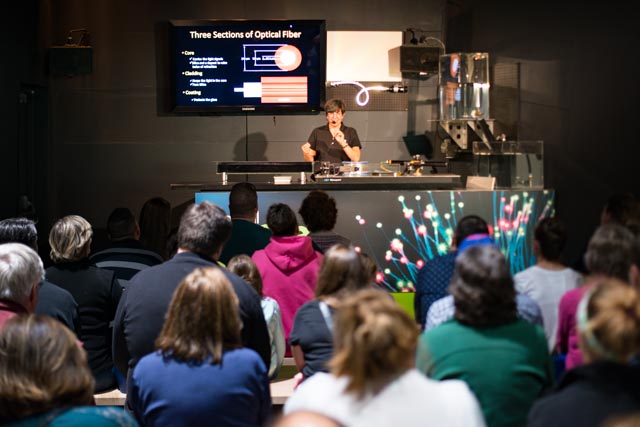
and the second in glass blowing . .
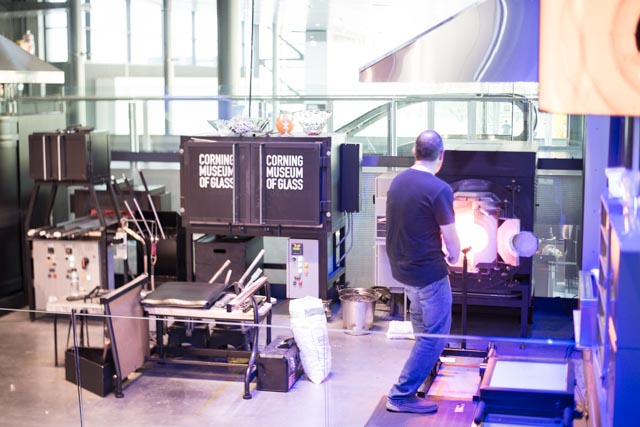
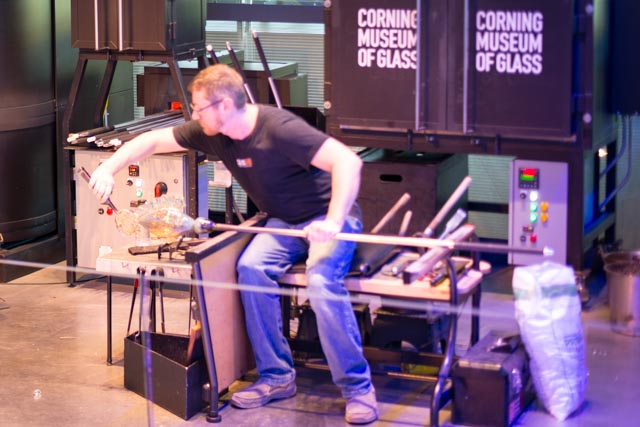
Both were very professionally done. We will return when we have a full day. Now, back to the road in an attempt to make up some time . . .

 Travelling with the Schinglers